Taiwan’s military posture in 2025 is more than a gradual upgrade—it is a comprehensive, society-wide transformation aimed at forging a rocky deterrence that blunts Beijing’s coercive ambitions at every level. The island’s defense strategy now rejects the old script of symmetric competition and instead embraces layered asymmetry, civil resilience, and strategic depth. Under pressure from escalating Chinese air incursions, missile tests, gray-zone operations, and a sharpened propaganda offensive, Taiwan has moved swiftly to harden its defenses, mobilize its population, and deepen external support—all while pivoting toward a war philosophy rooted in cost imposition and survivability.
From budget to battlefield, Taiwan’s 2025 defense reality is unmistakable. The government, led by President Lai Ching-te, has elevated defense spending to a record share of national resources—bonding pledges to keep military expenditure above three percent of GDP going forward, with the 2026 budget projected at approximately 3.3 percent. That allocation places Taiwan among the top defense burdened nations globally on a cost-of-defense basis, a calculated sacrifice reflecting the existential nature of the challenge (Reuters, AP News). It is a strategic financial posture intended to underpin Taiwan’s shift from complacency to deterrence. Within this broader budget, funds are being channeled into ramping up reserve capacity, modernizing hardware across every domain, and reinforcing civil-military synergy via the All-Out Defense Mobilization Agency, established to coordinate national resilience in wartime scenarios (Wikipedia—All-Out Defense Mobilization Agency).
The centerpiece of Taiwan’s renewed martial readiness is the annual Han Kuang Exercise, which in 2025 was deliberately extended and intensified. Running ten rigorous days and nights, this iteration drew over 22,000 reservists into a multi-domain war game that fused cyber threats, command-node disruption, urban defense, and societal resilience scenarios. Simulated missile barrages, communication blackouts, and forced decentralization of command revealed how deeply the island is integrating its civilian infrastructure into defense planning. Evacuation drills in Taipei, mapping of alternative communications using metro corridors, and the deployment of volunteer-led crisis response hubs reflected a mindset shift in Taipei—defense is not just in uniform; it is civic and territorial (Washington Post, Diplomat).
Taiwan’s military architecture now pivots on an asymmetric doctrine popularly described as the “porcupine strategy,” wherein even a smaller, presumably inferior, force can deter aggression by imposing disproportionate costs and complexities on invaders. This doctrine is reflected in the commissioning of novel systems like the homegrown Tuo Chiang stealth corvettes and the Hai Kun-class submarines, which emphasize speed, surprise, and maritime denial over head-to-head naval confrontation. Complemented by the induction of Brave Eagle jet trainers for preparing pilots against high-end threats, as well as mobile HIMARS rocket systems and layered air defenses including Sky Sword missiles, Taiwan is weaving a lethal deterrent net in the air, at sea, and on land (Wikipedia—Tuo Chiang-class corvette, WSJ). These investments are emblematic of a broader move: to survive, Taiwan must embed friction everywhere in the operational environment.
Personnel reforms are central to this transformation. Taiwan’s active armed forces, numbering around 150,000 to 169,000 members, are backed by approximately 1.65 million reservists organized into stratified categories from front-line battle units to civil defense forces. The government has raised conscription to 12 months and doubled incentives for volunteers, aiming to counter demographic declines and shifts in public sentiment that previously hindered recruitment. This calculated funneling of people into a meaningful, durable reserve structure is a quiet mobilization-engineering effort that few democracies would undertake without clear imperative (Wikipedia—Republic of China Armed Forces).
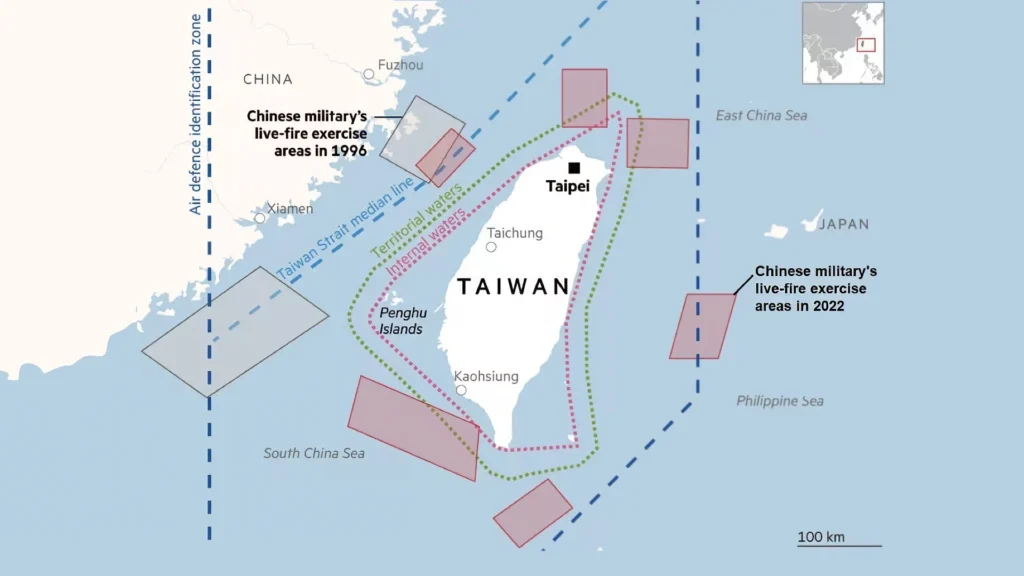
Against this backdrop of preparation, Beijing’s military lens has focused sharply on Taiwan. In 2025, PLA activities around the island grew in frequency and boldness: daily sorties into the Taiwanese ADIZ, repeated median-line crossings by fighters, gray-zone amphibious and electronic warfare operations, and large-scale missile drills in naval-aviation zones have become normalized. Far from symbolic, these actions underscore Beijing’s evolving brinkmanship and its pressure campaign aimed at both testing Taipei and compelling greater restraint from outside supporters (Wikipedia—2025 Taiwan Exercise, Reuters).
Taiwan’s response has not been confined to hardware. Its international posture has matured in parallel, reinforced through intelligence-sharing protocols, tabletop exercises, and increased liaison with the United States and select regional partners. Though not recognized diplomatically, Taiwan has deepened security ties via arms purchases, training exchanges, and multilateral planning frameworks, creating diffuse deterrence that stretches beyond formal treaties. Press-releases and white papers from Taiwan’s Quadrennial Defense Review emphasize urgency in syncing long-range strike capabilities, cyber resilience, and civil-military readiness with counterparts—an essential hedge against strategic ambiguity (Reuters).
Yet Taiwan’s defense posture is not immune to domestic tensions or strategic doubt. Privately, some defense planners acknowledge confusion in coalition planning—for example, pending questions around when U.S. forces might step in during a crisis. Wargame scenarios have sometimes faltered at the interface of intent and coordination, revealing that successful deterrence requires not only capability but also clarity in alliance dynamics and messaging. The distancing effect of erosion in U.S. strategic focus, or the rise of isolationist narratives, remains a concern. Still, the prevailing drive in Taipei is toward self-reliance: deterrence must be built and sustained at home, even if external support wavers.
Societally, the shift toward defense readiness is palpable. Civil volunteers, numbering in the hundreds of thousands, are now visible in training drills. Public shelters and evacuation infrastructure are on alert, civilian-led first responder training has expanded, and the All-Out Defense Mobilization Agency has introduced playbooks and contingency manuals to local governments and communities. This mobilization mindset is partly shaped by Taiwan’s experience managing cross-border threats, refugee inflows, and degradation of social cohesion during past operations. The goal: make the island’s survival instinct national and natural, not reactive or passive.
Under this garrison-like society—trained, networked, and armed—Taiwan’s deterrence deterrent takes new form. It is not built on intimidation or provocation, but on resilience, on being harder to defeat than to leave alone. A PLA invasion, if ever contemplated, would confront not only missiles and corvettes but a fragmented command, an armed citizenry, disrupted communications, clogged sea lanes, and an entire society unwilling to yield to swift subjugation.
Taiwan is forging that rugged shield today, through painful budgeting, strategic modernization, and ideological reinvention. The island’s defense path in 2025 is not about seeking victory in a pitched battle. It is about survival through adaptability, deterrence through cost, and sovereignty through cohesion. Its vigilance is no longer bound to kinetic confrontation—it is woven into the social fabric, the budget lines, the reserve rosters, and the homes of its two million active and reserve defenders.
As 2025 wears on, Taiwan sends a strategic signal beyond its borders: freedom will not be surrendered without a fight that is wide-ranging, deep-rooted, and uniquely Taiwanese. That layered resolve—civil, military, technological, ideological—is now the island’s truest defense.