
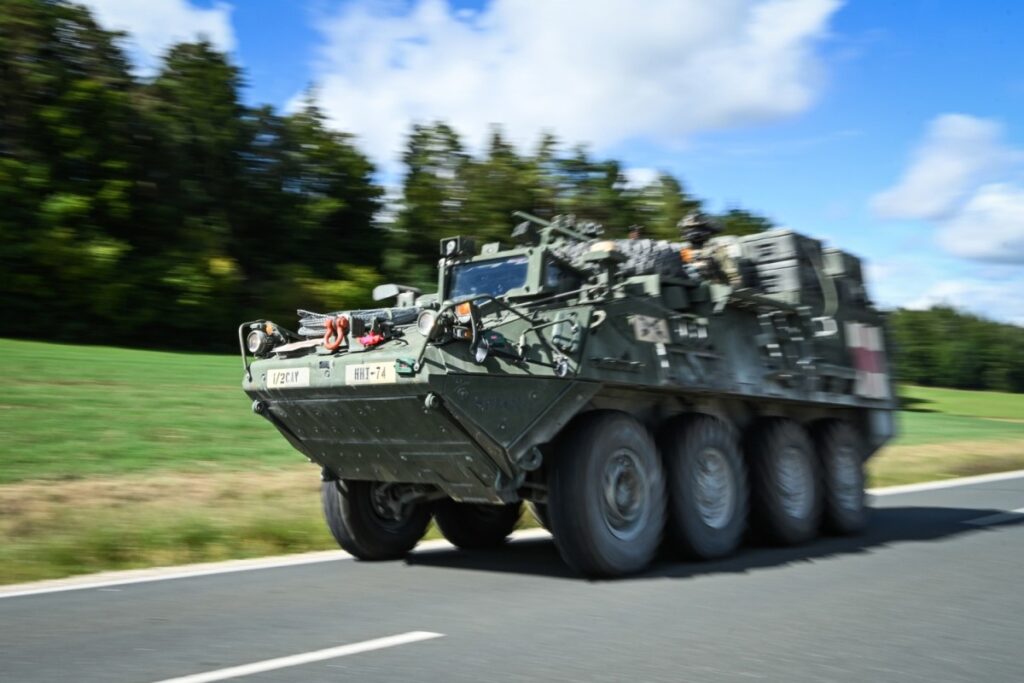
Saber Junction has matured into U.S. Army Europe and Africa’s signature combined-arms crucible, and this year’s rotation—Saber Junction 25—shows why the Joint Multinational Readiness Center at Hohenfels remains the toughest land-warfare classroom on the continent. The basic charter never changed: assess readiness to execute unified land operations while forcing interoperability with Allies and partners, but the 2025 design amplifies scale, tempo, and the joint texture of the problem. The exercise is led by 7th Army Training Command and staged across the Grafenwöhr and Hohenfels training areas, with the “box” at JMRC serving as the decisive test ground for a U.S. brigade fighting under a multinational division construct and flanked by constructed brigades that keep pressure high along the seams. The Department of Defense’s official spotlight distills the baseline—thousands of participants, roughly fifteen nations, southern Germany as the arena—while 7th ATC’s public page captures the purpose that has guided a decade of rotations: readiness and multinational integration under real stress, not scripted choreography (DoD Saber Junction; 7th ATC | Saber Junction).
The 2025 iteration is one of the largest Hohenfels rotations in years, running from mid-August through late September and moving well over seven thousand troops and roughly a thousand vehicles through a decisive-action template that denies quiet time and punishes staff latency. Official releases peg the window as 14 August to 21 September 2025, and they emphasize that this is the third major “Transformation in Contact 2.0” event of the year—an architecture change as much as an exercise label, aligning how brigades fight, sustain, and communicate against a peer who hits hard and quickly (rotation dates & scale; Army.mil convoy/update; 7th ATC | Exercises). The headline numbers vary by outlet—7,000+, 7,300+, 7,600+—but the framing is consistent: a multinational fight at brigade-and-division scale with a high density of armor, artillery, engineers, aviators, and enablers, all tracked by observer-coach-trainers who score performance against clear, published standards rather than soft narratives (DoD Saber Junction; 7th ATC recap video).
Hohenfels is not a generic training area; it is a living opposition ecosystem. JMRC’s resident OPFOR—anchored by 1st Battalion, 4th Infantry Regiment—specializes in making blue formations earn every kilometer with deception, tempo, and discipline. The unit’s mission as a professional opposing force is a permanent feature of the Bavarian training complex, and its presence is the reason seasoned battalion staffs talk about Hohenfels with the same tone aviators reserve for mountain check-rides. Imagery from Saber Junction 25 shows 1-4 Infantry in the OPFOR role again, and the Military OneSource unit listing underscores that “OPFOR” is not a temporary patch at JMRC; it’s a hardened function that trains daily to bleed assumptions out of rotating brigades (1-4 IN OPFOR at SJ25; USAG Bavaria Hohenfels | Major Units; 7th ATC | JMRC).
The blue training audience is heavy with U.S. formations but stitched to European partners at key tactical handoffs. V Corps’ 2nd Cavalry Regiment convoyed down from Grafenwöhr and rolled “into the box” in early September to assume a central role in the rotation, an important signal for a unit that spends its life forward in the heart of Europe. Public affairs imagery and stories also highlight a spread of Allied participants on the ground—from Dutch light armor to Bulgarian troops in the after-action review huddles—illustrating the real composition of a NATO fight where national hulls mix at the battalion task force level (2CR movement & role; Dutch 17th Light Armor at SJ25; Bulgarian participation). U.S. Army Europe and Africa’s newsroom packages and 7th ATC feeds amplify the point: this is not a U.S.-only laboratory with token observers; it is a multinational pressure cooker with real combined arms and combined staffs running combined problems in bad weather on bad roads under contact (USAREUR-AF newsroom; 7th ATC feed).
Air-ground integration is more than set-piece fly-bys; it is continuous friction between moving vehicles, layered air defenses, and aviation units that must find lanes, sling supplies, and deliver fires under jamming and dust. Saber Junction 25’s visual record shows repeat air participation, including b-roll from Hohenfels that captured Air Force Special Warfare and rescue elements nested with ground brigades, another hallmark of a JMRC fight where the air picture changes by the minute and aviation staffs are graded on whether they keep tempo through the sustainment sags that follow hard insertions (SJ25 b-roll, USAF 31st FW/57th RQS; scale, nations, vehicles). This is the environment where crews learn whether they can move CASEVAC in contact without unraveling the rest of the brigade’s plan and whether rotary-wing deconfliction holds when routes compress and command posts are jumping.
The structure of the rotation reflects lessons from last year’s iteration and from adjacent 7th ATC events. Saber Junction 24 built its scenario around a smaller nation fighting to restore its government against a larger northern aggressor, with the 173rd Airborne Brigade nested under an Italian division headquarters—an explicit nod to how a NATO corps-and-division fight really looks, not how a single brigade prefers to fight in isolation (inside the box, 2024; SJ24 overview). Combined Resolve 25-02 at JMRC earlier this year further exercised “Transformation in Contact” themes—live-virtual-constructive integration, faster staff cycles, and the multiplication of reconnaissance effects—which now show up as baseline expectations at Saber Junction 25 rather than exotic extras (Combined Resolve 25-02 | TiC 2.0; 7th ATC directorates).
Dates and numbers matter because they telegraph seriousness. The formal window for Saber Junction 25 spans 14 August to 21 September 2025; the convoy imagery of 2CR’s movement on 3 September and the steady drumbeat of DVIDS stories and USAREUR-AF photo releases in the first week of September confirm that the rotation is past its crawl phase and deep into the live-fire/force-on-force bell curve. Officials describe it as “one of the largest JMRC exercises in over a decade,” and the uniformity of public talking points across Army, Air Force, and USAREUR-AF channels points to a deliberate message: the alliance is training hard at scale, in contact, before winter shapes the ground again (dates & 2CR movement; largest in a decade, dates; USAREUR-AF photo set).
What does the box actually test that a garrison cannot? Command posts that can displace without losing fires and sustainment. Company-team commanders who can re-task organize under pressure when bridging assets blow timelines. Engineers who turn from gap crossing to counter-mobility without waiting for a perfect picture. Signalers whose links degrade gracefully rather than collapsing when hills and trees bite. The observers at Hohenfels grade these behaviors because OPFOR exposes them by design, and the OCT culture at JMRC means units receive specific, tactical critiques rather than general encouragement. The difference shows in after-action huddles where German, American, Dutch, and Bulgarian soldiers are seen hashing out timing, not swapping patches for social media (JMRC OCT/OPFOR mission; DVIDS SJ25 story; Dutch forces at SJ25).
There is a blunt logistics thread as well. Transformation in Contact is not a slogan; it is the Army’s Europe-based push to create more agile, mobile, survivable units that can rearm and repair under constant movement and sensor pressure. Even a quick look at the 7th ATC exercise hub and the official recap videos shows repeated emphasis on live-virtual-constructive overlays, dispersed command nodes, and shorter decision cycles. Those are choices with supply chain implications: more small-lot deliveries, more pre-positioned caches, fewer single points of failure in power and data. Saber Junction 25, like Combined Resolve 25-02, puts these choices under a stopwatch because the OPFOR and terrain force staff to move faster than their comfort zone would prefer (7th ATC | Exercises; TiC 2.0 explainer; SJ25 recap).
The multinational dimension is more than flags on a formation graphic. NATO and partner forces arrive with different radios, different logistics, different habits of command. The purpose of Hohenfels is not to iron those differences flat; it is to teach staffs how to plan around them so the brigade keeps tempo. USAREUR-AF’s newsroom pieces emphasize that “Allies and partner nations work in cohesion” at SJ25; the daily image streams back that claim with mixed patrols and mixed staff cells rather than national stovepipes, and the official DoD Saber Junction page remains clear that the event exists to harden interoperability under a realistic clock and with realistic friction (USAREUR-AF newsroom; DoD Saber Junction; Nations & scale).
For European audiences, the Hohenfels story connects to a wider 2025 training arc: season-long deployments and massed events like DEFENDER-series movements, Combined Resolve cycles, and national drills that stress rail, port, and road networks before combat power even sees a fight. USAREUR-AF’s exercise calendar and outreach products continuously link Saber Junction with allied events to demonstrate that the alliance is practicing the entire play: deploy, receive, move, fight, sustain, redeploy. AJMRC’s role is to keep the fight part honest—OPFOR that moves like a peer, OCTs who grade like action officers, and a terrain that punishes lazy assumptions in ways slides cannot (DEFENDER 25 outreach; JMRC role).
Comparisons to 2024 are instructive. Last year’s rotation ran 25 August to 19 September and highlighted airborne and multinational staff integration under a foreign division HQ—proof that 7th ATC is comfortable making U.S. brigades subordinate to European higher echelons as a matter of training routine, not exception. This year’s design folds in more vehicles and a longer window, aligns explicitly with Transformation in Contact 2.0, and brings additional air players into the ground picture by design rather than cameo. The through-line is that Saber Junction is not static; it evolves with the theater’s requirements and the alliance’s tempo (SJ24 dates/overview; SJ24 scenario; SJ25 scale).
What outcomes should commanders and ministers expect from Saber Junction 25 when the dust settles? Expect staff who rehearse displacement like a battle drill, not a pause menu. Expect battalion task forces that know how to re-task organize sustainment without waiting for perfect guidance. Expect allies who have practiced message-level sharing across data links rather than hoping national systems “just work.” Expect after-action reviews where the scorecards are framed against specific, repeatable objectives—bridge crossed on time, breach lanes maintained under counter-battery, counter-recon executed under JSTARS-free conditions—rather than generic “good exercise” declares. The open feeds show exactly those elements at work this week in Hohenfels, and the record from 7th ATC suggests the final buttoned-up product will be a brigade more confident in moving under contact and a division staff more confident in keeping its brigades supplied and synchronized across languages and laws (DVIDS SJ25 story; SJ25 staff/OC-T images; 7th ATC | Saber Junction).
The most useful way to understand Saber Junction 25 is to see it as a live audit. Every reported number—participants, nations, vehicles—matters, but the mechanism matters more: OPFOR who plan like adversaries, OCTs who coach like professionals, and Allies who share risk rather than photos. Germany’s Hohenfels training area remains the ground truth for this audit. The images and clips from the first week of September show mixed patrols in the woods line, after-action huddles with German observer-coaches, Dutch vehicles under security halts, and cavalry in the box while Army aviation slings to the next fight. That is not a parade; it is a rehearsal that produces skill the alliance can bank for winter, spring, or whenever the next emergency calls for formations that can move, shoot, communicate, and sustain under friction and without apologies (Allies Unite photo; Dutch security halt; helmet don/Desert Knights).