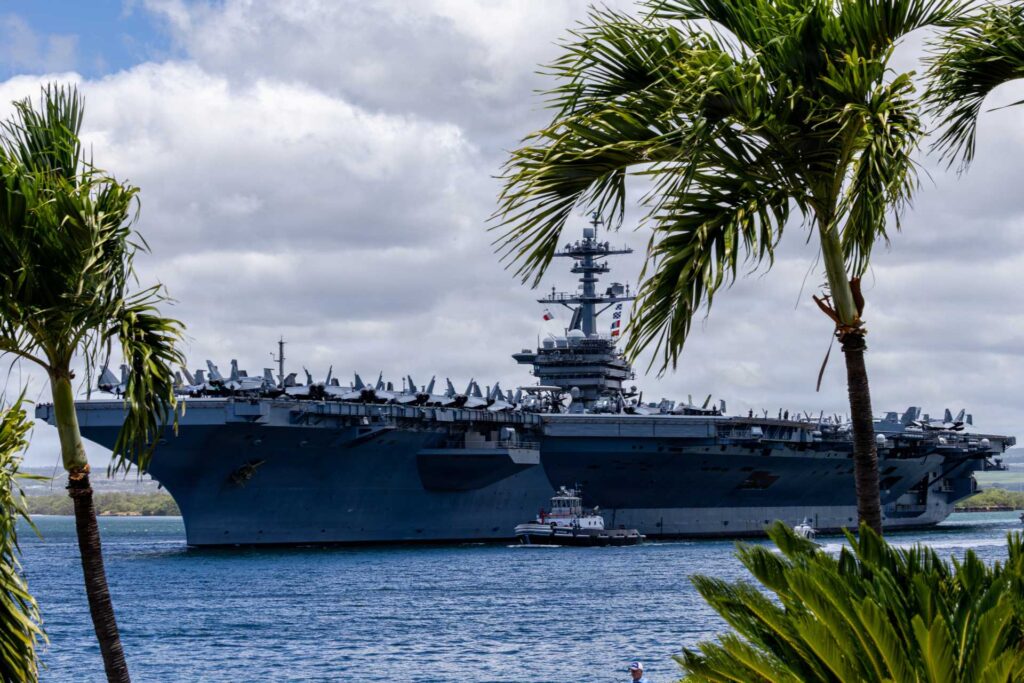
The Rim of the Pacific Exercise 2026 concluded around the Hawaiian Islands on July 31 after more than five weeks of multinational operations that brought together forces from 30 countries, more than 30,000 personnel, 30 surface ships, five submarines, 15 national land forces, and more than 197 aircraft, making the thirtieth iteration of RIMPAC one of the largest and most operationally diverse maritime exercises conducted anywhere in the world during 2026. Hosted by Commander, U.S. Pacific Fleet and spearheaded by U.S. Third Fleet, the exercise began on June 24 under the theme “Partners: Integrated and Prepared,” and its significance extended far beyond the familiar imagery of warships maneuvering in formation off Hawaii, since participating forces conducted more than 500 maritime training events, flew more than 2,400 sorties, and responded to more than 5,000 scenario-based operational problems while exercising maritime strike, anti-submarine warfare, integrated air and missile defense, amphibious operations, logistics, humanitarian assistance, disaster response, medical support, unmanned systems, advanced manufacturing, and multinational command and control. The U.S. Navy’s final RIMPAC 2026 assessment describes the exercise as a combined and joint training environment designed to improve the ability of participating nations to operate together across the maritime, air, land, and supporting domains, while the scale of the event provided something that smaller bilateral exercises cannot easily reproduce, which was the requirement to coordinate numerous national command systems, communications procedures, aircraft, submarines, surface combatants, amphibious forces, logistics ships, unmanned platforms, and land formations within one evolving operational structure.
The final participation figures are worth distinguishing from the numbers released during planning, since the U.S. Pacific Fleet initially announced that 31 nations, approximately 40 surface ships, five submarines, 140 aircraft, and more than 25,000 personnel were expected to participate, while the completed exercise ultimately involved 30 nations, 30 surface ships, five submarines, more than 197 aircraft, and over 30,000 personnel according to the Navy’s post-exercise accounting. The official 2026 participant roster records Australia, Brunei, Canada, Chile, Colombia, Denmark, Fiji, Germany, Greece, Guatemala, India, Indonesia, Israel, Italy, Japan, Malaysia, Mexico, the Netherlands, New Zealand, Peru, the Philippines, Poland, the Republic of Korea, Singapore, Spain, Sri Lanka, Thailand, Tonga, the United Kingdom, and the United States, giving RIMPAC an unusually broad geographic composition that included Pacific powers, NATO members, Latin American states, Southeast Asian countries, and smaller maritime nations whose forces would rarely have an opportunity to operate simultaneously within a force of this size. The Philippine Coast Guard, Fiji, Greece, Guatemala, Poland, and Spain made their RIMPAC debuts, while the combination of established participants and new entrants demonstrated that the exercise has evolved from the relatively small event first conducted in 1971 into a mechanism through which countries with different equipment, languages, doctrines, and alliance relationships can develop a working degree of maritime interoperability before a real crisis requires it.
The hardware assembled for RIMPAC 2026 reflected this multinational character, with the official ship roster including the Australian destroyer HMAS Sydney, Canadian frigates HMCS Ottawa and HMCS Regina, Chilean frigate Almirante Cochrane, Italian combat ship Giovanni delle Bande Nere, Japanese destroyer JS Kongo, Republic of Korea destroyer ROKS Jeongjo the Great and frigate ROKS Daejeon, Mexican ships ARM Juarez and ARM Usumacinta, New Zealand frigate HMNZS Te Mana and replenishment ship HMNZS Aotearoa, Peru’s BAP Pisco, Philippine Navy frigate BRP Miguel Malvar, Philippine Coast Guard ship BRP Gabriela Silang, Singapore’s RSS Steadfast, Spain’s ESPS Alvaro de Bazan, and a substantial American force centered on the aircraft carrier USS Theodore Roosevelt and the amphibious assault ship USS Essex. The submarine component was equally international, combining the Republic of Korea Navy’s ROKS Dosan Ahn Changho, the U.S. Navy attack submarines USS Columbia and USS Charlotte, Peru’s BAP Chipana, and Canada’s HMCS Corner Brook, while replenishment support included American Military Sealift Command vessels and allied logistics ships that had to sustain an unusually heterogeneous fleet at sea. These forces were not assembled merely for a ceremonial fleet review, since the exercise required them to work through the practical incompatibilities that emerge when different national combat systems, aviation procedures, communications conventions, logistics standards, command structures, and rules for operating aircraft and ships must function together under time pressure, which is one reason the operational value of RIMPAC lies as much in identifying friction as it does in demonstrating polished formations.
From Multinational Presence to Multinational Command
One of the most consequential features of RIMPAC 2026 was the degree to which multinational participation extended into the command structure itself, since the exercise did more than place foreign vessels under an overwhelmingly American tactical framework and instead assigned senior coalition officers responsibility for major components of the combined force. U.S. Navy Vice Adm. Jeff Jablon commanded the overall RIMPAC Combined Task Force, Japan Maritime Self-Defense Force Rear Adm. Takuo Kobayashi served as vice commander, Chilean Navy Commodore Andres Howard served as deputy commander, Republic of Korea Navy Rear Adm. In-ho Kim commanded the Combined Force Maritime Component, and Royal Canadian Air Force Brig. Gen. J. S. Davis commanded the Combined Force Air Component, while additional leadership responsibilities were distributed among other participating nations. A Chilean officer commanded the Maritime Logistics Support Element and became the first representative from a non-Anglophone partner nation to lead that mission, an Indian Navy representative served as deputy commander of the theater anti-submarine warfare task force, a Peruvian Navy representative commanded the combined amphibious task force, and Canadian leadership was also embedded in maritime patrol and reconnaissance aviation and coalition medical training. The importance of these arrangements lies in the fact that coalition warfare depends on more than technical compatibility between weapons, since multinational commanders must understand what forces from other countries can actually do, how quickly they can receive and interpret orders, which authorities remain under national control, how information can legally and technically be shared, and how rapidly a combined headquarters can reach a decision when the operational picture is changing.
RIMPAC was deliberately organized in phases that increased this integration over time, beginning with an in-port phase in which staffs established command relationships and planned operations before progressing to a sea phase involving anti-submarine warfare, maritime strike, air and missile defense, amphibious operations, and logistics, after which the exercise concluded with a free-play scenario in which opposing forces were required to respond dynamically to one another. This progression matters because scripted demonstrations can prove that individual events have been rehearsed, while a free-play environment places greater pressure on command judgment, information flow, communications discipline, planning speed, and the ability of dispersed units to respond when the opposing side behaves differently from expectation. The Navy’s post-exercise accounting of more than 500 maritime events, more than 2,400 flight sorties, and more than 5,000 operational problem sets gives an indication of the amount of decision-making and coordination involved, while the breadth of the training ranged from traditional gunnery, anti-submarine warfare, mine countermeasures, explosive ordnance disposal, diving, and salvage to medical response, cyber-supported operations, humanitarian relief, and technologically experimental activities. The resulting exercise was therefore less accurately understood as thirty navies conducting parallel training in the same ocean than as a temporary multinational force attempting to build enough procedural, technical, and human integration to function as a coalition.
The carrier USS Theodore Roosevelt provided the most visible concentration of American naval aviation during the exercise, while USS Essex supplied a large-deck amphibious platform that became particularly important for experimentation, logistics, aviation integration, medical support, and amphibious operations, yet RIMPAC’s force structure also demonstrated how contemporary maritime operations increasingly depend on distributed capabilities extending far beyond a carrier strike group. The exercise incorporated surface combatants carrying different national radar, missile, and command systems, submarines representing several design philosophies, maritime patrol aircraft, helicopters, land-based forces, logistics vessels, Coast Guard assets, unmanned systems, and expeditionary units operating from Hawaii, creating an environment in which sensing, targeting, air defense, undersea surveillance, logistics, and amphibious movement had to cross organizational boundaries repeatedly. The official conclusion highlighted several examples that would have been uncommon in earlier exercises, including a Royal Australian Navy MH-60R helicopter detachment embarking aboard a U.S. Navy destroyer, the Republic of Korea Navy operating its newly introduced P-8A Poseidon in combined anti-submarine warfare, and U.S. Army rotary-wing aircraft operating from USS Essex in support of sea-basing concepts. Each of these events tested a different form of interchangeability, since the real question was whether one nation’s aircraft, crew, data, or operational procedure could be incorporated into another nation’s platform and command structure without the entire force having to stop and create a bespoke solution.
The undersea portion of RIMPAC carried particular significance because submarine warfare remains one of the most technically demanding areas of coalition integration, with success depending on acoustic sensing, environmental knowledge, identification procedures, aviation support, surface-ship coordination, communications, and the management of friendly submarines operating within the same broad battlespace. The presence of American nuclear-powered attack submarines alongside Canadian, Peruvian, and South Korean submarines created a training environment in which forces had to work around different acoustic characteristics and operating procedures, while the Republic of Korea Navy’s use of the P-8A Poseidon added another modern maritime patrol capability to the multinational anti-submarine effort. The Navy’s final summary specifically identified combined anti-submarine warfare as a major component of the at-sea phase and also noted India’s leadership role within the theater anti-submarine warfare task force, which illustrates how RIMPAC is increasingly being used to develop command expertise across national boundaries as well as tactical proficiency among individual ships and aircraft. The strategic importance of this training is difficult to separate from the geography of the Indo-Pacific, where enormous distances, deep-ocean operating areas, strategically important straits, submarine fleets, and vulnerable maritime supply routes make undersea awareness a central element of both deterrence and wartime naval operations.
RIMPAC’s live-fire sinking exercises provided the most dramatic demonstration of combined maritime strike, with participating ships, aircraft, and land-based forces sinking the decommissioned guided-missile cruiser USS Mobile Bay on July 12 and the former amphibious assault ship USS Peleliu on July 17 in deep water more than 50 nautical miles north of Kauai. According to the U.S. Navy’s official account of the SINKEX events, units from Australia, Canada, Italy, Japan, New Zealand, Spain, and the United States participated in the live-fire activity, while U.S. Army, Air Force, and Navy elements were involved within the broader strike architecture and Spanish frigate ESPS Alvaro de Bazan was documented launching a Harpoon missile against Peleliu. The value of a SINKEX extends beyond demonstrating that a missile or other weapon can physically strike an obsolete hull, since the exercise requires surveillance, identification, command authorization, target-quality information, coordination among shooters, timing, range safety, and assessment of the target after successive engagements, which makes it a test of the wider strike chain as well as individual weapons. The Navy also stated that the sinking areas were surveyed and that the exercises were conducted under applicable environmental permits and statutory requirements, an important point given the environmental sensitivity surrounding live-fire activity in Hawaiian waters.
The amphibious component similarly reflected a shift toward multinational operations extending across sea, air, and land, with Peru leading the combined amphibious task force and multinational forces conducting ship-to-shore movement, helicopter-borne assault activity, landing-craft recovery, tactical casualty care, and land training at locations in Hawaii. RIMPAC has always had an amphibious dimension, yet its significance has increased as maritime forces consider how expeditionary units can operate across widely separated islands and coastal areas while depending on naval aviation, sealift, logistics, communications, and land-based sensing, and the 2026 event placed these problems inside a coalition framework in which different nations contributed ships, marines, aircraft, or command personnel. The Navy’s final report highlighted a large-scale amphibious operation involving U.S. Navy and Marine Corps forces alongside multinational partners, while USNI reported that Republic of Korea marines conducted ship-to-shore operations and that Peru’s command role validated multinational planning across maritime, air, and land components. Such activity does not make participating forces identical in doctrine or capability, although it does allow them to discover whether basic procedures for movement, communications, casualty evacuation, aviation support, and command can survive contact with the practical differences between national militaries.
RIMPAC as a Laboratory for Distributed Naval Operations
The most revealing aspect of RIMPAC 2026 may ultimately prove to be its extensive experimentation with unmanned systems and emerging technology, since USNI reported that more than 35 experiments were conducted during the exercise and described activities involving unmanned surface vessels, autonomous logistics, advanced manufacturing, artificial intelligence, and new methods of connecting distributed forces. One highly visible event involved an unmanned surface vessel maneuvering into the well deck of USS Essex to deliver additively manufactured supplies, while the medium-displacement unmanned surface vessel Sea Hunter also operated during the exercise and other digitally crewed vessels were used to move parts between locations. The importance of these experiments lies in the attempt to move autonomy beyond isolated technology demonstrations and place it inside an operational fleet whose ships are maneuvering, replenishing, maintaining aircraft, conducting exercises, and coordinating with foreign partners, since a vehicle that operates successfully at a test range may still prove difficult to use when it must communicate with existing command networks, approach a crewed warship safely, function in congested waters, or deliver useful cargo within the rhythm of real fleet operations. Vice Adm. Jablon described the experimentation as a way of receiving operator feedback early, which is precisely the type of environment needed to determine whether an emerging system solves an operational problem or simply performs an impressive technical demonstration.
Advanced manufacturing was integrated into the same operational experiment, with the U.S. Pacific Fleet and Naval Postgraduate School describing the effort as the largest advanced manufacturing demonstration conducted by the department, while systems were placed aboard USS Theodore Roosevelt, USS Essex, allied support ship MV Asterix, and locations ashore in Hawaii and elsewhere within a distributed network. The objective went beyond placing a 3D printer on a ship, since the experiment attempted to connect a digital request for a part with available design information, qualified manufacturing capacity, production, inspection, and eventual delivery to the operating unit, while unmanned vessels were incorporated into portions of the delivery chain. More than 50 manufacturing nodes distributed across military installations, universities, manufacturing centers, and operational locations were connected within the broader demonstration, which reflects a logistics concept in which some replacement parts could eventually be produced closer to the force instead of waiting for every item to travel through a conventional depot and transportation network. This remains an evolving capability with substantial requirements involving certification, material quality, intellectual property, cybersecurity, dimensional accuracy, and engineering approval, yet RIMPAC offered the scale necessary to determine where the concept encounters real friction when ships, technicians, databases, manufacturers, and transportation systems must operate together.
The emphasis on manufacturing was closely related to a much older naval requirement that RIMPAC also exercised extensively, which was the ability to sustain ships at sea without forcing the entire force back into port, and the multinational replenishment effort demonstrated why logistics remains the foundation beneath every advanced weapon or sensor used during a maritime campaign. Military Sealift Command’s USNS Guadalupe and USNS Washington Chambers delivered aviation fuel, marine diesel, food, equipment, and other supplies to American and foreign vessels while conducting multiple replenishments at sea, sometimes serving ships on both sides during the same evolution, while Canadian MV Asterix and New Zealand’s HMNZS Aotearoa added allied replenishment capacity to the force. The Military Sealift Command account of RIMPAC logistics also emphasized that multinational replenishment introduces practical differences involving procedures, communications, chains of command, and even measurement systems, all of which have to be reconciled at sea where small misunderstandings can become safety problems. This part of the exercise deserves more attention than it usually receives because a coalition that can exchange targeting data yet cannot exchange fuel, stores, repair capability, or medical support will lose operational coherence as soon as its ships exhaust the supplies carried when they sailed.
RIMPAC 2026 also retained a substantial humanitarian assistance and disaster response mission, which reflects the reality that Indo-Pacific military forces are frequently called upon after earthquakes, tsunamis, typhoons, volcanic eruptions, flooding, and other natural disasters whose scale overwhelms local transportation and medical capacity. Eleven nations and more than 1,700 personnel participated in the humanitarian assistance and disaster response scenario, which included urban search and rescue, mass-casualty response, aerial assessment, port restoration, dive operations, logistics movement, and interaction with nongovernmental and international organizations, while the planning phase involved institutions including U.S. Pacific Command’s Center for Excellence in Disaster Management and Humanitarian Assistance, the United Nations Office for the Coordination of Humanitarian Affairs, the World Food Programme, the Changi Regional HADR Coordination Centre, and the Pacific Disaster Center. Japan Maritime Self-Defense Force Rear Adm. Takuo Kobayashi led the HADR task force, and the official Third Fleet summary reported that 37 multinational units responded to 46 simulated requests for assistance while construction, medical, logistics, and communications teams worked through the scenario. These activities exercise many of the same capabilities required during military operations, including damaged-port restoration, transportation coordination, communications interoperability, medical triage, aviation management, and the distribution of supplies, while giving participating states a framework for cooperation in crises that do not involve armed conflict.
The balance between combat training and disaster response also reveals the broader political function of RIMPAC, since the exercise creates military relationships that may be used in deterrence, wartime operations, maritime security, humanitarian crises, evacuation missions, search and rescue, or natural-disaster response, and these relationships can matter even when participating governments do not share identical strategic objectives. The United States describes its network of allies and partners as a major strategic advantage in the Indo-Pacific, while RIMPAC gives those relationships a practical form by forcing officers and crews to solve problems together before an emergency occurs, yet participation should not be mistaken for automatic political alignment on every future contingency. A country may be willing to practice anti-submarine warfare, humanitarian assistance, or replenishment at sea with the United States while retaining its own policy toward China, territorial disputes, sanctions, or regional military operations, and the true value of a multinational exercise lies partly in discovering the limits as well as the possibilities of coalition action. The multinational command arrangements used in 2026 were therefore especially important, since coalition effectiveness ultimately depends on whether partner states possess both the technical capacity and political confidence to assume meaningful responsibility rather than functioning solely as supporting units within an American operation.
RIMPAC also takes place inside Hawaii, where the exercise is experienced very differently by residents than it is by crews observing the event from warships or headquarters, and the 2026 iteration again generated opposition from Native Hawaiian, anti-war, environmental, and other activist organizations concerned about militarization, sovereignty, effects on marine life, live-fire training, military land use, and the broader environmental footprint of large exercises. Hawaiʻi Public Radio reported that protesters gathered at the state Capitol after the exercise and raised concerns involving communities, marine life, climate, and Hawaiian sovereignty, while demonstrations also accompanied the beginning of RIMPAC in June. These objections exist alongside the Navy’s position that major activities are conducted under environmental review, permits, range-safety procedures, and applicable federal environmental law, including the specific environmental precautions described for the 2026 sinking exercises, and any serious assessment of RIMPAC has to recognize that Hawaii is simultaneously a strategic military hub, the physical training environment that makes the exercise possible, and the homeland of communities that bear its local effects. Treating this debate as peripheral misses an important element of long-term military readiness, since access to training areas ultimately depends on environmental stewardship, lawful operation, infrastructure resilience, and a sustainable relationship with the communities surrounding them.
The strategic meaning of RIMPAC 2026 becomes clearer when its individual activities are considered together, since the exercise did not demonstrate one revolutionary weapon and instead tested whether a large coalition could connect traditional naval power with emerging technologies, distributed logistics, land forces, unmanned systems, aviation, submarines, digital manufacturing, medical support, and multinational command within one operational framework. The presence of USS Theodore Roosevelt demonstrated conventional carrier airpower, the five submarines represented the continuing importance of the undersea domain, the sinking exercises demonstrated coalition maritime strike, the amphibious operations connected ships with land forces, the replenishment network showed how the fleet could remain at sea, the manufacturing experiments examined ways to shorten the repair chain, and the unmanned demonstrations explored how autonomous platforms might increase capacity without requiring a crew aboard every vessel. None of these capabilities can be assessed entirely in isolation because modern maritime warfare is increasingly a problem of networks and logistics, in which a highly capable ship can become operationally irrelevant if it lacks fuel, ammunition, targeting information, communications, maintenance, or compatible command relationships, while comparatively modest platforms can become more useful when they contribute sensing, transport, deception, communications, or distributed mass to a larger force. RIMPAC’s scale allowed these interdependencies to become visible in ways that a single-platform trial cannot reproduce.
The exercise also exposed how the meaning of interoperability is changing, since earlier multinational naval cooperation often concentrated on common communications procedures, formation maneuvering, refueling, and basic tactical coordination, while RIMPAC 2026 increasingly dealt with interchangeability of aircraft, multinational command, shared logistics, distributed manufacturing, unmanned systems, common operational data, and cross-national participation within specialized areas such as anti-submarine warfare and air operations. True interchangeability remains difficult because national forces use different weapons, communications security systems, classification rules, data formats, legal authorities, maintenance standards, and training systems, while even apparently minor differences can become serious under combat conditions, yet exercises such as RIMPAC create a place where those differences can be identified before they must be solved during an actual crisis. Japan’s vice-command role, South Korea’s command of the maritime component, Canada’s leadership in the air component, Chile’s deputy-command and logistics responsibilities, Peru’s amphibious leadership, and India’s anti-submarine command role collectively demonstrated a deliberate effort to distribute responsibility throughout the coalition rather than simply increasing the number of flags displayed at Pearl Harbor. This is likely to remain one of the most strategically important dimensions of future RIMPAC exercises as the United States seeks forces capable of operating with partners across the immense distances of the Pacific.
By the time ships returned to Pearl Harbor at the end of July, RIMPAC 2026 had produced a much broader body of operational experience than its headline numbers alone suggest, with hundreds of maritime events, thousands of aircraft sorties, two major sinking exercises, multinational anti-submarine operations, amphibious assaults, advanced manufacturing trials, unmanned logistics, at-sea replenishment, medical operations, disaster-response training, and a final free-play phase that required the combined force to respond dynamically to an opposing element. The exercise’s thirtieth iteration also demonstrated how much RIMPAC itself has changed since the series began in 1971, since contemporary maritime power now includes software, autonomy, digital logistics, distributed production, information sharing, commercial technology, and joint land-based capabilities alongside ships, submarines, and aircraft. The official RIMPAC 2026 conclusion emphasized trust and interoperability as the exercise’s enduring objectives, and those concepts can sound abstract until they are translated into concrete questions involving whether a Canadian aircraft can operate within a multinational command structure, whether a foreign frigate can safely refuel from an American logistics ship, whether an Australian helicopter can operate from an American destroyer, whether a coalition commander can direct ships belonging to several sovereign governments, or whether a damaged vessel can obtain a replacement component through a distributed manufacturing network while remaining deployed. RIMPAC exists to answer those questions under controlled conditions before circumstances require the answers in a real emergency.
RIMPAC 2026 should therefore be understood as more than a large naval exercise and more than a public demonstration of American and allied military power, since its deeper purpose was to test whether an extraordinarily diverse group of forces could become sufficiently integrated to operate as a combined maritime system while preserving the national identities, authorities, and technical differences of the countries contributing them. The exercise showed considerable progress in multinational command, live-fire integration, undersea warfare, amphibious operations, logistics, advanced manufacturing, autonomy, and disaster response, while it also highlighted the permanent difficulties surrounding communications compatibility, sustainment, coalition decision-making, environmental stewardship, and the political complexity of conducting large military exercises in Hawaii. Future maritime conflict, should deterrence fail, would almost certainly place greater stress on every one of these functions than a scheduled exercise can reproduce, with logistics under attack, communications degraded, ships damaged, commercial supply chains disrupted, satellites contested, and commanders forced to make decisions with incomplete information, which makes the value of RIMPAC less dependent on how impressive the final formation photograph appears and more dependent on whether the participating forces discovered their weaknesses early enough to correct them. In that sense, RIMPAC 2026 was both a demonstration of existing military capability and a large-scale experiment in how multinational maritime power will have to function in an Indo-Pacific security environment where distance, technological change, contested logistics, and coalition warfare are becoming inseparable elements of the same operational problem.