
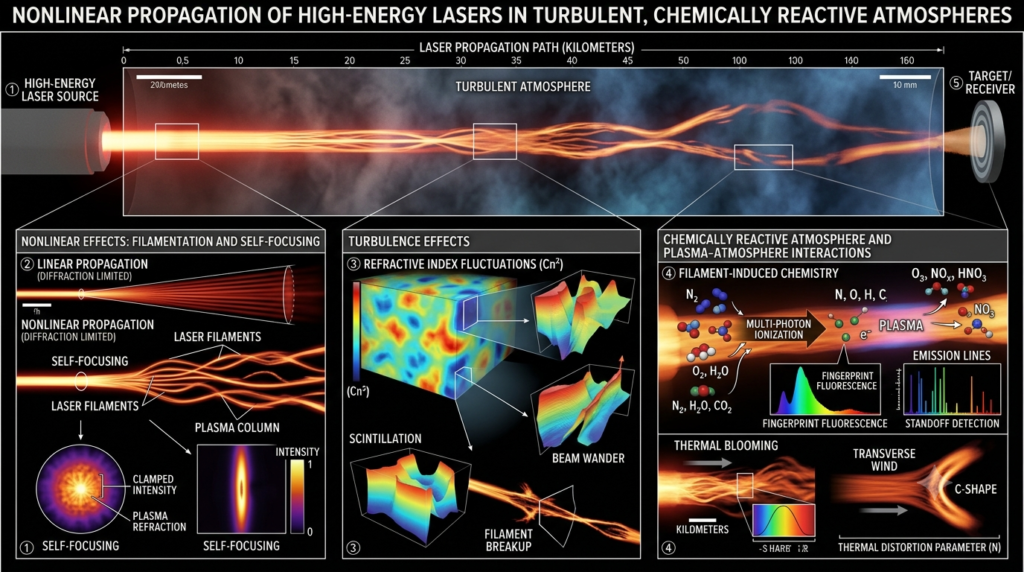
A high-energy laser traveling through the atmosphere does not move through empty and passive space, since the air along its path contains molecules, aerosols, droplets, temperature gradients, pressure variations, turbulent eddies, combustion products, trace pollutants, and sometimes partially ionized or chemically unstable material, all of which can absorb, scatter, refract, distort, and react to the radiation while the beam itself changes the physical state of the medium through which it is passing. At low optical intensity, many propagation problems can be approximated as linear, which means that the atmosphere influences the beam while the beam produces no significant change in the atmosphere, yet this approximation begins to fail as power, pulse energy, peak intensity, dwell time, or path length increases, since absorbed energy heats the gas and suspended particles, local heating changes density and refractive index, intense fields can drive nonlinear polarization and ionization, and newly produced chemical species or aerosols can alter absorption and scattering after the beam has already begun to propagate.
The resulting problem is therefore a feedback system in which optical energy changes the atmosphere and the modified atmosphere reshapes the optical field, while wind, convection, turbulence, and chemical kinetics continually transport those changes away from the beam axis and replace them with new material. This coupled behavior matters in long-range sensing, laser communications, remote spectroscopy, atmospheric research, power transmission, industrial monitoring, and directed-energy systems, since all of these applications depend on delivering a controlled optical field through air that is neither uniform nor stationary. The central difficulty is that the atmosphere possesses structure across an enormous range of scales, from molecular absorption lines and microscopic aerosol particles to centimeter-scale refractive-index fluctuations, meter-scale turbulent cells, cloud layers, weather systems, and chemically complex plumes extending over many kilometers, so a beam that appears well behaved in a laboratory may become unstable, broadened, displaced, fragmented, or strongly attenuated when exposed to the full variability of an outdoor path.
The HITRAN molecular spectroscopic database exists precisely because atmospheric transmission depends on the detailed absorption properties of hundreds of molecular species, while the long history of high-power laser propagation research has shown that absorption, scattering, turbulence, wind, and beam-induced heating must be treated as parts of the same physical system rather than as isolated corrections applied after an ideal beam calculation.
The Atmosphere as an Active Optical Medium
The first layer of the problem arises before any strong nonlinearity develops, since ordinary air already possesses a wavelength-dependent optical structure controlled by molecular absorption, Rayleigh scattering, aerosol extinction, cloud droplets, humidity, temperature, and pressure, which means that wavelength selection determines how much energy is deposited into the path and which constituents receive that energy. Water vapor and carbon dioxide produce extensive infrared absorption structure, oxygen and other gases contribute additional bands, and trace species can become important in polluted, maritime, industrial, volcanic, or combustion-affected environments, while aerosols may dominate extinction even within spectral regions that appear comparatively transparent when only molecular gases are considered. The widely used concept of an atmospheric window can therefore be misleading when treated as a fixed opening in the spectrum, since every apparent window contains narrower molecular lines, weak continua, aerosol contributions, and weather-dependent changes that become consequential over long distances or at high transmitted power. Research on atmospheric absorption and laser propagation has long emphasized the role of water vapor and carbon dioxide in defining infrared transmission, while modern work on broadband mid-infrared pulse propagation shows how molecular absorption and dispersion can reshape a pulse even when the total path appears transmissive at lower spectral resolution.
In a chemically reactive atmosphere, the transmission spectrum becomes even less stable because hot gases broaden and redistribute absorption features, reaction products appear and disappear, humidity changes as combustion or condensation proceeds, and soot or salt particles acquire coatings that alter their optical properties, so the beam encounters an extinction field that changes with position, time, and the chemical history of the air mass. This is why realistic propagation analysis relies on line-by-line spectroscopy, meteorological profiles, aerosol models, and local measurements rather than a single generic attenuation coefficient, since a small amount of absorption distributed over a long path can produce substantial heating, while concentrated absorption in a plume or cloud can create a localized refractive element that dominates the entire downstream beam.
Atmospheric turbulence introduces a second source of complexity by producing random, moving fluctuations in temperature and density that change the refractive index across the beam aperture, with each turbulent layer acting like a constantly evolving collection of weak lenses and prisms that bend different parts of the wavefront by different amounts. The most visible consequences include beam wander, broadening, scintillation, focal shift, loss of coherence, speckle, and intermittent concentration of energy into bright patches, yet these effects are not merely visual degradation, since local intensity fluctuations determine where absorption, heating, ionization, and chemistry occur most strongly. A beam that has been broken into moving hot spots by turbulence deposits energy differently from a smooth beam of the same average power, and those hot spots can seed new thermal gradients, local plasma formation, droplet evaporation, or chemical reaction, after which the atmosphere no longer resembles the unperturbed turbulent medium assumed at the beginning of the calculation.
The strength and vertical distribution of turbulence also change with sunlight, terrain, wind shear, cloud cover, surface heating, altitude, and weather, which makes a correction designed for one moment progressively inaccurate as the path evolves. NASA’s work on atmospheric propagation effects relevant to optical systems and its practical experience with laser communications through clouds and turbulence illustrate why optical links require site selection, weather monitoring, pointing control, and adaptive correction even when transmitted powers remain far below the level at which thermal blooming becomes dominant. At high energy, turbulence also creates a measurement problem because the return signal used to estimate the outgoing wavefront may sample a different atmospheric state from the one encountered by the transmitted beam, particularly when the target moves, the path is long, the wind carries heated air across the line of sight, or the beam itself has already altered the refractive structure, so compensation must be predictive rather than purely reactive.
Thermal blooming develops when a portion of the laser energy is absorbed by gases or aerosols and converted into heat, causing the illuminated air to expand, decrease in density, and acquire a refractive-index distribution that behaves like a lens generated by the beam itself, with the resulting phase distortion usually spreading, displacing, or defocusing the energy that created it. The phenomenon is nonlinear because a stronger local beam produces more heating, the heating changes the optical path, and the altered optical path redistributes the beam in a way that changes subsequent heating, while transverse wind, natural convection, and mechanical turbulence determine whether the heated channel remains near the beam axis or is swept away. Under a steady crosswind, the heated region can become asymmetric and produce a characteristic distortion or centroid shift, while weak wind and long dwell time allow heat to accumulate and can drive stronger defocusing or convection.
The underlying process has been studied for decades, yet recent high-precision thermal blooming calculations and laboratory experiments continue to refine the connection between modeled distortion and measured beam quality, while work on thermal blooming with laser-induced convection shows that buoyant flow generated by heating can reshape the refractive channel even when the ambient medium initially appears nearly stagnant. Aerosols are especially important because a path that is weakly absorbing in clean air may heat strongly in smoke, dust, haze, sea salt, or pollution, and the composition of those particles determines whether they primarily scatter radiation, absorb it, evaporate, fragment, oxidize, or undergo a phase change. This means that thermal blooming cannot be predicted from beam power alone, since the same source can behave differently over desert terrain, humid maritime air, an urban boundary layer, a wildfire plume, or an engine exhaust, while the relevant atmospheric state may change during a single experiment as wind shifts and the beam modifies the particle population.
Turbulence and thermal blooming do not simply add two independent distortions to the same beam, because each process changes the conditions under which the other develops, and the combined system can display competition, reinforcement, intermittency, and thresholds that are absent from either effect in isolation. Turbulence may disperse a heated region before it grows into a strong thermal lens, yet it may also create intense speckles that heat selected parts of the path more rapidly, while wind that transports turbulence across the aperture also advects the beam-generated temperature field and causes the optical distortion to lag behind the instantaneous intensity pattern. Recent analysis of the competition between atmospheric turbulence and thermal blooming found that increasing initial power density does not necessarily produce a proportional increase in average delivered intensity, which reflects the broader principle that once the beam significantly modifies the medium, additional source power can be redirected into stronger distortion rather than useful concentration at the destination.
The coupled field can also develop phase singularities and discontinuities that complicate adaptive-optics correction, since a deformable mirror can compensate a smoothly varying wavefront more readily than a wavefront that has become fragmented by deep scintillation, branch points, or rapid nonlinear evolution. Older and newer studies alike therefore distinguish between correction of turbulence in a passive atmosphere and correction of a beam-generated atmospheric lens, because the latter changes in response to the correction itself, creating the possibility that an apparently beneficial command will move energy into a region that heats more strongly and destabilizes the next control cycle. This feedback explains why successful propagation requires attention to controller latency, wind transport, beacon geometry, target motion, sensor noise, and the time history of deposited energy, rather than treating adaptive optics as a universal filter that can recover any distorted beam after the fact.
Reactive Gases, Aerosols, Clouds, and Laser-Induced Chemistry
The phrase chemically reactive atmosphere includes far more than ordinary humid air, because many realistic optical paths cross exhaust plumes, flames, smoke, dust, sea spray, industrial emissions, wildfire products, volcanic material, or clouds containing droplets and ice particles, and each of these environments combines optical inhomogeneity with active chemical and thermodynamic evolution. A combustion plume contains steep temperature gradients and fluctuating concentrations of water vapor, carbon dioxide, carbon monoxide, nitrogen oxides, hydrocarbons, radicals, salts, metal compounds, and soot, while turbulent mixing draws surrounding oxygen and cooler air into the plume and continually changes the local reaction rate, density, and refractive index. Computational work on laser propagation through jet plumes using fluid-dynamic simulations demonstrates why a realistic optical calculation must be connected to the underlying flow field, because the plume is not a stationary absorbing screen and its refractive structure depends on velocity, temperature, composition, mixing, and combustion. Spectroscopic studies of water vapor and temperature in propagating flames also show that radiative transport through a combustion region is strongly affected by spatial inhomogeneity, especially when hot-band absorption and rapidly changing product concentrations become important. In such a medium, the laser may heat gases that are already reacting, alter local ignition or extinction behavior, evaporate condensed material, or change the balance between gas-phase and particle-phase species, while the plume responds through expansion, mixing, oxidation, and radiation. The optical field therefore carries information about the chemistry and simultaneously perturbs the chemistry, which complicates any attempt to infer atmospheric state from a received signal or to maintain a stable focal distribution through the plume.
Clouds and fog illustrate the same feedback in a different physical form, because water droplets scatter and absorb light, yet a sufficiently energetic beam can heat, evaporate, deform, or shatter those droplets, creating a path whose optical properties evolve during illumination. A detailed model of high-energy laser propagation through clouds includes droplet and vapor heating, droplet shattering, and feedback through changes in the complex refractive index, showing that the beam can create a partially cleared channel while the moving boundary of that channel continues to affect propagation. The effect is not equivalent to simply reducing cloud density, because evaporation adds water vapor that may absorb at the laser wavelength, fragments can increase the number of scattering centers, heated vapor can drive local expansion, and wind or turbulence can refill the path with new droplets. Ice clouds add further complexity through nonspherical particles, orientation effects, melting, sublimation, and wavelength-dependent scattering, while mixed-phase clouds can shift between droplet and crystal populations as local temperature changes. Smoke and dust behave differently because carbonaceous particles, mineral grains, and salt aerosols possess distinct absorption spectra and thermal responses, yet they share the same general ability to convert optical energy into localized heating and to modify the beam through time-dependent extinction. NOAA research on the optical properties of biomass-burning aerosols emphasizes how particle shape, aggregation, size, and refractive index control scattering and absorption, which means that two plumes with similar visual opacity can produce very different thermal and optical effects on a high-energy beam.
At sufficiently high peak intensity, particularly for ultrashort pulses, the dominant nonlinearity changes from slow thermal accumulation to an ultrafast competition among intensity-dependent refraction, self-focusing, plasma generation, dispersion, diffraction, and energy loss, producing narrow filamentary structures that can extend over distances far greater than an ordinary geometric focus. The standard physical picture begins when the optical field modifies the refractive response of air strongly enough to focus itself, after which the rising intensity ionizes molecules and creates plasma that tends to defocus the beam, with repeated dynamic balance allowing a bright filament to persist while generating broadband radiation, acoustic waves, free electrons, ions, radicals, and excited species. The extensive review of atmospheric nonlinear optics and laser filamentation describes this regime as a platform for remote sensing and atmospheric applications, while field measurements of laser-assisted water condensation show that filaments can generate chemically active conditions capable of promoting droplet growth when humidity is sufficiently high. This is a fundamentally different propagation regime from continuous or long-pulse thermal blooming, yet the two can coexist in high-repetition-rate systems because individual pulses produce ultrafast ionization and chemistry while the accumulated average power heats the air, drives convection, and establishes a longer-lived refractive channel. The atmosphere therefore retains memory across multiple timescales, with electrons disappearing rapidly, excited and radical species reacting over longer intervals, aerosols and droplets persisting still longer, and thermal or convective structures surviving long enough to influence later pulses, so the propagation of a pulse train depends on repetition rate and environmental recovery as much as on the properties of an isolated pulse.
Laser-induced chemistry gives the phrase reactive atmosphere its strongest meaning, because intense optical fields can dissociate and ionize oxygen and nitrogen, produce ozone and nitrogen oxides, generate hydroxyl radicals in humid air, oxidize volatile organic compounds, and create low-volatility products that condense onto existing particles or nucleate new aerosol. Field and laboratory work on nonlinear photochemical pathways in laser-induced atmospheric aerosol formation found that filamentation can increase particle number and mass while producing ammonium nitrate and oxidized organics, and the experiments further showed that water droplets can intensify local oxidative chemistry by enhancing the production of reactive radicals. Once new particles form, they alter scattering, absorption, humidity uptake, and cloud-condensation behavior, which feeds back into subsequent propagation and creates a chemically mediated optical memory that may outlast the plasma responsible for initiating it. In polluted air, sulfur dioxide, ammonia, nitrogen oxides, and organic vapors provide additional reaction pathways, while in maritime air, salt particles and high humidity influence both aerosol growth and refractive-index structure, and in combustion plumes, radicals and partially oxidized hydrocarbons create a different network of reactions. The optical path can therefore evolve from a molecular gas to a multiphase mixture containing ions, radicals, droplets, and newly formed particles, with each phase transporting energy and matter on a different timescale. This behavior also means that a high-energy beam can modify the validity of the atmospheric measurements used to control it, since a diagnostic pulse, beacon, or transmitted beam may change the very aerosol and chemical field that the sensor assumes it is observing passively.
Reactive environments can also produce abrupt transitions rather than smooth degradation, because chemical kinetics, phase changes, breakdown, and ignition often possess thresholds, while turbulence creates intermittent regions that cross those thresholds only for brief periods. A speckle intensified by turbulence may locally exceed the level required for ionization, droplet shattering, rapid evaporation, or surface ablation even when the beam’s average intensity remains below that level, while a chemically absorbing species concentrated in a thin layer can produce a sharp thermal lens that would be invisible in a model based on path-averaged composition. The same intermittency can work in the opposite direction when wind moves a reactive plume out of the beam or when heating clears droplets from one part of the aperture, so measured transmission may jump between states rather than decline smoothly. These threshold effects create hysteresis because the state reached after strong illumination may persist after the power decreases, especially when new aerosols have formed, a cloud channel has been cleared, convection has reorganized the flow, or combustion chemistry has shifted to a new branch. A propagation model that uses only the current beam power and current meteorological state can therefore miss the influence of earlier pulses, prior dwell, and preconditioning of the path. The practical implication is that nonlinear atmospheric propagation must be treated as a time-dependent initial-value problem with memory, uncertainty, and multiple possible states, particularly when the atmosphere is humid, polluted, cloud-bearing, or chemically active.
Modeling, Measurement, and Control of the Coupled Propagation Problem
A credible model of high-energy laser propagation through a turbulent and chemically reactive atmosphere must connect several physical descriptions that are usually studied separately, including wave optics for diffraction and phase evolution, statistical turbulence for random refractive-index fluctuations, radiative transfer for absorption and scattering, fluid dynamics for wind and convection, thermodynamics for density and temperature changes, chemical kinetics for species production and loss, plasma physics for ionization and electron dynamics, and aerosol or cloud microphysics for particle growth, evaporation, fragmentation, and transport. No single numerical method resolves all of these processes from molecular scales to kilometer paths, so practical simulations divide the system into coupled modules and exchange quantities such as intensity, deposited heat, refractive index, species concentration, particle distribution, and velocity field between them. Split-step propagation and phase-screen methods efficiently represent diffraction and turbulence over long paths, computational fluid dynamics supplies three-dimensional temperature and velocity structure, spectroscopic databases provide wavelength-dependent molecular absorption, and chemistry solvers track reactions, while stochastic ensembles are required because one turbulence realization cannot represent the distribution of possible outcomes. NASA’s development of a high-fidelity multilayer atmospheric turbulence simulator reflects the need to reproduce layered and evolving distortion in controlled experiments, while plume-propagation work based on computational fluid dynamics shows how measured or simulated flow fields can be converted into optical-path perturbations. The hardest modeling challenge is often closure rather than raw computation, because uncertain aerosol composition, poorly measured humidity profiles, unresolved turbulence, unknown reaction products, and imperfect boundary conditions can dominate the result even when the propagation algorithm itself is accurate.
Measurement must therefore accompany modeling at every stage, with meteorological sensors, scintillometers, lidar, wavefront cameras, imaging receivers, spectrometers, aerosol instruments, and target-plane diagnostics used together to determine what the atmosphere is doing before, during, and after illumination. A conventional wavefront sensor reveals phase distortion across an aperture, yet it may not identify whether the distortion came from ordinary turbulence, a hot exhaust plume, beam-induced heating, or transmitter boundary-layer effects, while intensity imaging detects scintillation and fragmentation but provides incomplete information about the underlying refractive field. Spectroscopy can identify absorbing molecules and estimate temperature or concentration, aerosol instruments can constrain particle size and composition, and lidar can map clouds or backscatter, yet each measurement has its own sampling volume and time response, so data fusion becomes essential when the atmosphere changes faster than a scanning instrument can reconstruct it.
The use of broadband and multispecies spectroscopy is especially valuable in reactive plumes because water vapor, carbon dioxide, carbon monoxide, hydrocarbons, and nitrogen-containing products can change together, while the HITRAN database provides the spectroscopic foundation for translating observed absorption into atmospheric state. In field systems, the best estimate of the path will often come from combining remote sensing with local weather data and the optical return from the beam itself, then updating a predictive model continuously as wind carries turbulent and heated structures across the line of sight.
Adaptive optics remains one of the principal methods for correcting phase distortion, using wavefront sensing, fast computation, steering mirrors, and deformable mirrors to reshape the outgoing beam before it enters the atmosphere, yet nonlinear propagation imposes limits that are less severe in astronomy or low-power communications. A controller can compensate measured turbulence when the atmospheric response remains approximately independent of the transmitted intensity, but thermal blooming and plasma formation change in response to the corrected beam, which means that the control action alters the plant being controlled.
A sharper beam may deliver more energy to the desired location while also increasing absorption and heating along a critical section of the path, and a correction based on delayed data may place energy into the position where a heated refractive channel has moved rather than where it currently resides. JPL’s work on adaptive predictive control addresses the broader problem of constantly evolving turbulence and system disturbances by updating controller behavior as atmospheric statistics change, and the same predictive philosophy becomes even more important when high energy creates additional time-dependent distortion.
Effective control may combine adaptive optics with wavelength management, temporal scheduling, beam shaping, path diversity, aperture scaling, weather selection, and real-time estimates of absorption or aerosol loading, although the optimum combination depends strongly on the application and should be assessed through validated models and controlled testing rather than universal design rules.
The distinction between mitigation and elimination is essential, because no optical control system can make a dense cloud, an opaque smoke layer, a strongly absorbing molecular band, or a rapidly evolving combustion plume behave like vacuum, while even clear air contains irreducible turbulence, molecular absorption, and weather variability. Engineering success therefore depends on recognizing the dominant regime early enough to choose a useful response, whether that means correcting wavefront distortion, changing the timing of transmission, selecting a clearer path, reducing dwell, using another spectral region, shifting to a different site, or accepting that the atmosphere has temporarily closed the optical channel. Civil laser communication networks already use geographically separated ground terminals and weather awareness to improve availability, because clouds can block an otherwise excellent optical link, and similar logic applies to high-energy transmission whenever environmental variability exceeds the correction authority of the optical system. The broader lesson from nonlinear propagation is that atmospheric state belongs inside the system design rather than outside it as a late performance penalty, since source architecture, beam control, diagnostics, operational timing, and environmental sensing must be developed together.
The scientific importance of this field extends beyond the problem of delivering energy to a distant point, because high-energy beams provide controlled ways to study nonequilibrium gas dynamics, plasma formation, aerosol chemistry, cloud microphysics, turbulent transport, and the coupling between radiation and reactive matter. The same physical mechanisms that degrade a beam can become diagnostic signals, since changes in phase, spectrum, polarization, scattering, acoustic emission, and fluorescence reveal properties of the path, while laser-induced perturbations make it possible to observe how atmospheric systems relax after rapid energy deposition. Research on filament-induced condensation and aerosol formation has already shown that intense light can reorganize local atmospheric chemistry in measurable ways, and cloud-interaction models demonstrate that droplets and vapor can participate in dynamic feedback rather than acting as fixed obstacles. These results also impose a responsibility to evaluate environmental effects, measurement bias, and unintended chemical production when experiments use high repetition rates or operate in polluted and humid air, because a beam capable of creating ozone, nitrogen oxides, oxidized organics, or new particles is interacting with the atmosphere as a chemical reactor as well as an optical medium.
Nonlinear propagation in turbulent, chemically reactive atmospheres is therefore best understood as a coupled evolution of light, heat, motion, phase, and composition, with no fixed boundary separating optical physics from meteorology, fluid mechanics, plasma science, and atmospheric chemistry. Turbulence redistributes intensity, absorption converts part of that intensity into heat, heat changes density and refractive index, wind and convection move the resulting structure, intense fields create plasma and reactive species, chemistry changes the aerosol and molecular population, and the altered medium reshapes every later portion of the beam. The process can remain weak and correctable, grow gradually into thermal blooming, or cross thresholds into filamentation, breakdown, droplet disruption, particle formation, and other strongly nonlinear states, while the outcome depends on the full history of the path as well as its instantaneous condition. Accurate prediction therefore requires spectroscopic data, meteorological measurement, turbulence characterization, multiphysics simulation, controlled experiments, and adaptive control designed for a medium that responds to illumination. The atmosphere is part of the laser system from the moment the beam leaves its aperture, and at sufficiently high energy it becomes an active, evolving component whose dynamics determine whether optical power remains concentrated, disperses harmlessly, or drives a new physical and chemical state along the path.