
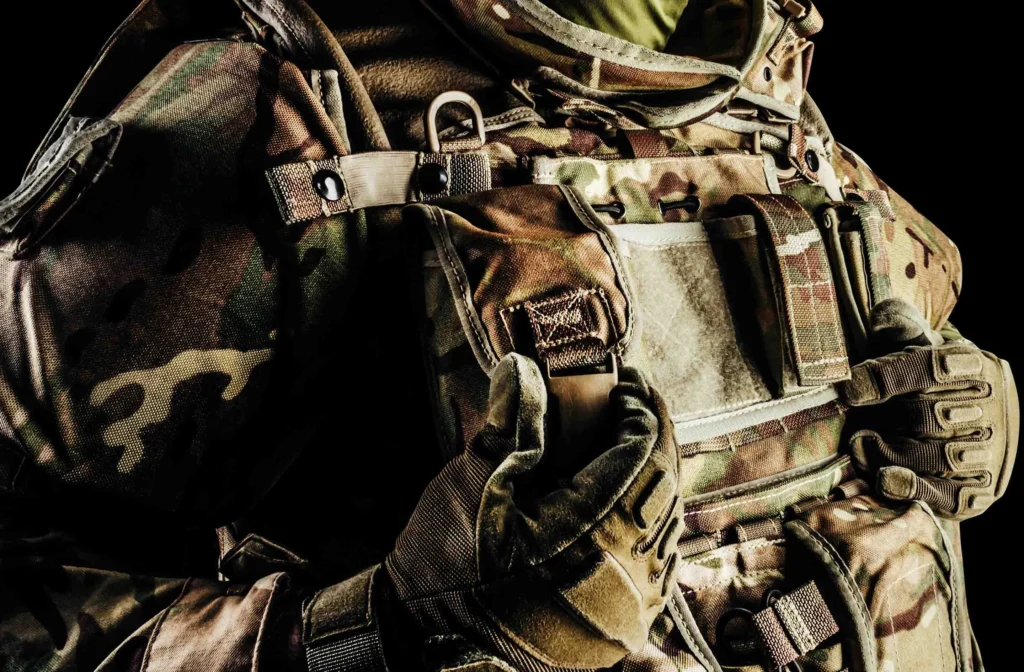
Infantry armor is built around one brutal equation: every kilogram of protection cut from the plate or vest is a kilogram that can go back into mobility, ammunition, sensors, or simply a soldier’s physical and cognitive margin. Next-generation armor materials aim to shift that equation by delivering more ballistic and blast performance per unit weight and volume, not just incremental tweaks to existing steel or aramid solutions. On the U.S. side, the baseline is already advanced: law-enforcement armor is governed by NIJ Standard 0101.06 and now NIJ Standard 0101.07, while Army programs such as the Soldier Protection System define a modular, scalable PPE architecture for combat forces.(National Institute of Justice) The direction of travel is clear: lighter plates and soft armor, more coverage, smarter integration with the rest of the soldier system, and better confidence in performance over the full service life of the gear.
Contemporary infantry armor is essentially an energy-management stack. The legacy Interceptor Body Armor system, described in Army technical manuals such as TM 10-8470-208-10 for IOTV GEN I & II, couples an outer tactical vest with hard plates and modular attachments to increase coverage on the shoulders, flanks, and groin.(Fort Benning) The vest distributes load and stops fragments; the ceramic or composite plates defeat rifle threats; auxiliary components extend protection into vulnerable zones without overwhelming the soldier. Later evolutions such as the Improved Outer Tactical Vest and current SPS variants maintain this basic architecture but push hard on weight reduction, fit, and scalability. Army communications around SPS, including “New Soldier armor weighs less, offers more options” and Fort Carson field tests of new body armor, emphasize modular scalable vests, ballistic combat shirts, and improved pelvic and extremity protection as key steps toward a next-generation protective ensemble.(Army)
The formal performance envelope for torso armor is set by NIJ and mirrored, in more demanding form, in military qualification protocols. NIJ’s current ballistic standard NIJ 0101.07 and the new ballistic protection level specification NIJ 0123.00 redefine threat levels and test threats to better represent modern handgun and rifle ammunition while reducing confusion for end users.(National Institute of Justice) The NIJ Compliance Testing Program and its ballistic armor compliant products list then determine which commercial models actually meet those requirements under standardized test and conditioning protocols.(National Institute of Justice) On the defense side, the Department of Defense testing guidance in “DoD Testing Requirements for Body Armor” details how Interceptor and related systems must perform under ballistic and environmental trials, including multi-hit performance, shot-to-edge spacing, and durability testing.(U.S. Department of War) These documents collectively define what “good enough” means before any new material or architecture goes near a soldier.
Underpinning those standards is a substantial measurement and modeling effort, led on the civilian side by the National Institute of Standards and Technology. NIST’s “Body Armor and Related Materials” research program concentrates on the links between high-strength fiber properties and system-level armor performance, the characterization of novel high-performance materials, and the long-term stability of fibers in service.(NIST) Efforts summarized in publications such as “A New Way to Test Body Armor” demonstrate new single-fiber and yarn-level test methods that probe deformation and failure at realistic ballistic strain rates, while degradation-model evaluations for high-strength p-phenylene fibers help agencies understand how temperature, humidity, and mechanical flexing erode performance over time.(NIST) This physics-based foundation is critical to next-gen materials, because it lets designers treat the armor not as a black box but as a system where microstructure, chemistry, and geometry can be tuned deliberately for better outcomes.
On the science and technology strategy side, the National Academies’ report “Opportunities in Protection Materials Science and Technology for Future Army Applications” lays out the roadmap for how metals, ceramics, polymers, and composites can be improved for lighter, more capable armor.(National Academies Press) The report emphasizes the specific strength advantage of advanced ceramics, the potential of architected composites, and the value of integrated computational materials engineering as summarized in “Integrated Computational Materials Engineering” for compressing development cycles.(National Academies Press) Taken together, NIJ, NIST, and the National Academies define a technology vector: lightweight, multi-material systems whose performance is predicted and validated from the fiber and grain scale up to full-plate impacts.
At the core of these systems sit high-performance polymer fibers. The earliest soft armor relied heavily on aramids such as Kevlar and PBO, but field failures in certain vests forced NIJ and NIST to dig deeply into degradation mechanisms. NIST’s overview “Testing Program on Fibers Used in Ballistic Applications” and related Material Matters articles document how mechanical testing, microscopy, and x-ray scattering are used to track chemical and physical changes in fibers over time and how those changes correlate with drops in ballistic performance.(NIST) Meanwhile, NIJ’s discussion of draft revisions to the ballistic-resistant standard and the next revision of NIJ 0101.06 highlight why service-life limits and more rigorous conditioning protocols became non-negotiable for compliant armor.(National Institute of Justice) For next-gen infantry systems, these lessons harden the requirement that any new fiber family, whether an advanced UHMWPE or a novel nanocomposite, must come with a credible aging and reliability story, not just spectacular initial V50 numbers.
Ultra-high-molecular-weight polyethylene has already displaced aramids in many hard and soft armor applications because of its combination of low density and high tensile strength. NIST’s “Structure-Property Relationships for High-Strength Materials” program and body-armor projects focus heavily on such fibers, exploring how drawing conditions, molecular orientation, and defects control performance.(NIST) The next step is to treat these fibers and their polymer matrices as designed metamaterials: by tuning filament diameter, cross-ply angle, binder stiffness, and interfacial chemistry, engineers can sculpt how stress waves propagate through the laminate during impact. Research highlighted by NIST, such as novel characterization techniques for high-strength materials, supports exactly this kind of optimization, and it feeds directly into Army requirements under the Soldier Protection System and DEVCOM’s physics-based protection programs.(NIST)
At the strike face, advanced ceramics remain irreplaceable. The National Academies’ protection-materials work stresses that boron carbide, silicon carbide, and tailored aluminas offer specific strengths far beyond those of metals, which is why they anchor nearly all rifle-rated plates in service today.(National Academies Press) Yet conventional monolithic tiles have well-known weaknesses: they are vulnerable to cracking, edge hits, and multi-hit degradation. Army research centers and DARPA’s Soldier Protection Systems (SPS) program are therefore moving toward architected and functionally graded ceramics that manage crack initiation and growth more intelligently.(DARPA) Nature-inspired architectures play a key role here. MIT work such as “Conch shells spill the secret to their toughness” and “Nature gives a lesson in armor design” shows how multi-scale layering and zigzag crack paths can produce shells an order of magnitude tougher than common nacre.(MIT News) Similar design motifs are now being implemented in additively manufactured ceramic composites and graded ceramic–polymer stacks for plates and helmet shells.
Metallic materials have not disappeared from the picture. Technical appendices in the National Academies’ reports, along with Army technology briefs such as the “Soldier Protection” feature in Army Technology Magazine, describe how high-strength steels and aluminum alloys still provide essential blast, spall, and structural protection, especially in vehicle underbody and turret applications.(Army API) For dismounted infantry, metals now appear mainly as thin facesheets, strike-face boosters, edge-reinforcement rings, and structural load paths in carriers and exoskeleton interfaces. The value lies in pairing them intelligently with ceramics and composites to capture multi-hit robustness and ductile energy absorption without reverting to legacy steel-plate weight penalties. Here, integrated computational materials engineering as discussed in the ICME report from the National Academies provides the methodology to co-optimize material composition, heat treatment, and geometry for very specific load cases.(National Academies Press)
One of the most disruptive trends is the rise of architected and lattice materials whose performance is driven as much by geometry as by chemistry. MIT and related research programs have demonstrated nanostructured materials that stop projectiles far more efficiently than traditional plates; the MIT News piece “Stronger than a speeding bullet” is the canonical example for this line of work.(MIT News) The U.S. National Science Foundation recently highlighted a two-dimensional, chainmail-like interlocked polymer in “Chainmail-like polymer could be the future of body armor”, a material that combines exceptional strength, flexibility, and an extremely high density of mechanical bonds.(NSF – U.S. National Science Foundation) This kind of interlocked, ultra-thin architecture is exactly what infantry armor designers want for extremity protection and flexible torso coverage: fabrics that behave like cloth while delivering performance closer to a rigid plate under high strain-rate loading.
Auxetic and other mechanical metamaterials are also under active consideration for helmets and padding. Although much of the detailed work is still found in technical literature, the broad direction aligns with what Army and DARPA protection programs already advertise publicly: hierarchical structures that can stiffen, soften, or redirect energy based on load. The Institute for Soldier Nanotechnologies at MIT has spent years on bio-inspired armor architectures, from fish-scale-inspired protective systems to gels and ultrafine fibers for blast and impact mitigation.(MIT News) As those concepts mature, the expectation is that metamaterial-style layers will appear under or between conventional plates and soft armor, tuning the overall response to both blunt and penetrative threats.
Another cluster of next-generation ideas revolves around rheology and phase-like response. Shear-thickening fluids (STFs) that flow freely at low strain rates but stiffen sharply under impact have been a recurring focus at both Army and NIST. Army Research Laboratory communications, such as the “Shear Thickening Fluid” ARL Inside feature and related coverage on fabrics fortified with shear-thickening suspensions, show how impregnating Kevlar-like fabrics with nanoparticle suspensions can dramatically increase resistance to spikes, knives, and certain projectile threats.(Army Innovation) NIST’s work on the physics behind shear-thickening, described in articles such as “A crack in the mystery of ‘oobleck’ – friction thickens fluids”, supports this by explaining how frictional contacts between particles control the transition from liquid-like to solid-like behavior.(NIST) For infantry armor, STFs promise soft garments that remain supple during patrol but harden instantly when struck, provided long-term stability and environmental robustness issues can be solved.
The trajectory toward “smart” and multifunctional armor is equally important. PEO Soldier’s Soldier Protection System portfolio already includes elements such as the Integrated Head Protection System and the Next Generation IHPS, both lighter than earlier helmets and designed to accept accessories, mandible guards, and sensors.(PEO Soldier) The same portfolio covers ballistic combat shirts, blast pelvic protectors, and scalable plates that let units tailor protection to threat and mission. As next-gen materials come on line, these subsystems will need to host not only ballistic layers but also embedded electronics and power distribution, turning the armor into a platform for sensing and computation as well as protection.
On that front, research groups associated with the Army, Navy, and MIT have already demonstrated textile-integrated computing. The MIT News article on a “fiber computer” that allows apparel to run apps and understand the wearer describes an elastic fiber containing sensors, memory, processing, and Bluetooth communications, tested with U.S. service members on Arctic missions.(MIT News) Once such fibers are married to ballistic carriers and soft armor, next-gen infantry armor could monitor blast overpressure, track fatigue, manage thermal load, and report hits or damage automatically. The materials challenge is to integrate these fragile electronics within robust, wash-able, field-maintainable composites without creating new failure modes.
All of this innovation is constrained by test and qualification science. NIJ’s active standards list shows how ballistic, stab, and other PPE standards must evolve together, and the draft and final versions of NIJ 0101.07 show the way toward more representative test threats, improved backface deformation criteria, and clearer protection level naming.(National Institute of Justice) NIST fills in the measurement gaps with work such as near-edge ballistic impact studies, aging models, and micro-to-macro performance correlations, so that certifiers can have confidence that novel architectures behave as expected under edge hits, multi-hit scenarios, and real-world wear conditions.(NIST Publications) Without this backbone of test science, advanced materials would remain trapped in the lab, unable to cross what the National Academies describe in “Accelerating Technology Transition: Bridging the Valley of Death for Materials and Processes in Defense Systems” as the long, risky gap between demonstration and fielding.(National Academies Press)
For commanders and program managers, the operational implications are straightforward. The Soldier Protection System concept is explicitly described by the Army as “a modular, scalable integrated system of mission-tailorable ballistic protective subsystems at reduced weight,” which directly leverages advanced fibers, ceramics, and integration techniques to cut burden compared to the IOTV.(PEO Soldier) Field reports such as “New protective gear saves Soldier’s life” and Soldiers’ testimonials about body armor performance validate the underlying physics with real-world outcomes: plates and vests that stop rounds they were designed to stop while imposing less fatigue and better fit across a diverse force.(Army) As new materials enter that system, the most valuable metric is not exotic lab performance but how many kilograms of armor can be traded for either increased survivability elsewhere on the body or increased maneuver capacity with no loss of protection against defined threats.
Taken together, next-generation armor materials for infantry protection look less like a single miracle material and more like a layered, integrated ecosystem. High-performance fibers, UHMWPE laminates, architected ceramics, carefully placed metal reinforcements, shear-thickening binders, and metamaterial cores each handle different parts of the threat and load spectrum. Research programs at NIJ, NIST, PEO Soldier, DARPA, and the National Academies are converging on a shared vision where armor is lighter, smarter, more modular, and more predictable across its service life.(NIST) For the dismounted soldier, the payoff is blunt: plates and garments that feel less like a penalty and more like an integrated part of a combat system, preserving mobility and lethality while quietly absorbing the physics of incoming fire.