
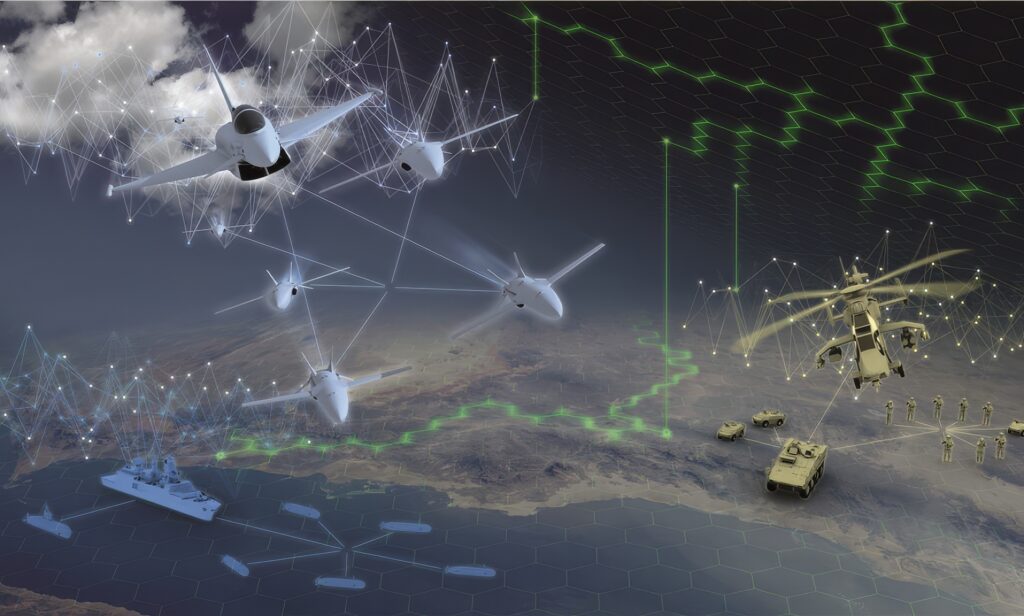
Coastal A2/AD works only when sensing, classification, and fires survive the mess of surf clutter, multipath, ducting, civilian traffic, and a smart adversary’s electronic warfare; that is why modern coastal defenders stitch long-range high-frequency horizons, passive illuminators of opportunity, seabed listeners, and shore batteries into a kill web that keeps custody on targets, hands off credentials, and closes the trigger loop even as jammers and decoys try to saturate receivers and break trust. The practical baseline today blends venerable fixed undersea listening—e.g., the U.S. Navy’s Integrated Undersea Surveillance System (IUSS; About IUSS)—with coastal high-frequency surface-wave radar (HF radar basics — NOAA IOOS; Oceanography intro PDF; RUCOOL explainer), over-the-horizon radar like Australia’s JORN (DST; BAE Systems), and a resurgence of passive/bistatic schemes that harvest commercial emitters to see without radiating (passive radar overview; DSIAC on PCL). When the geometry works and the network stays synchronized, this fabric detects, localizes, and confirms enough to arm containerized coastal missiles that threaten shipping lanes and amphibious build-ups; when EW pressure rises, the web devolves into local pictures, and decoy emissivity plus barrage noise force operators to guess. The center of gravity is therefore not any single sensor but the integrity of the hand-offs that turn many partial glimpses into a weapon-quality track.
HF surface-wave radar (HFSWR) is the coastal staple because ground-wave propagation lets 3–30 MHz energy ride the ocean surface beyond line of sight, tracking vessels and wave fields from fixed shore sites; it is cost-effective for EEZ coverage and has matured through adverse-conditions ops and oceanography into ship-tracking roles (NOAA IOOS; Oceanography intro PDF). In littorals, HFSWR delivers early cues but must contend with ionospheric variability, sea-state-dependent clutter, and Doppler mixes that challenge CFAR logic, so system designers pair it with passive receivers and optical confirmation. Over-the-horizon backscatter radar—for example JORN—extends detection deep into open approaches with skywave returns, while its elevation/azimuth ambiguities and temporal fading drive the need for multistatic geometry and fusion (DST JORN; USSF fact sheet; BAE). These radars cue patrol aircraft, UAVs, and coastal shooters, but the picture remains probabilistic unless additional geometry pins range and class.
Bistatic and multistatic radar exploit separated transmit/receive sites to gain clutter diversity and survivability; passive coherent location systems exploit broadcast FM, TV, GNSS, and even SAR satellites as illuminators of opportunity, granting detection without revealing a radar’s position (passive radar; PCL primer — DSIAC; C-PCL academic paper). FM-based systems have repeatedly demonstrated aircraft and maritime target tracking by riding commercial power, while GNSS-based maritime MTI shows detectability of slow movers when the bistatic geometry is favorable; the trade is exquisite synchronization and calibration to keep ghosting and elevation holes from fooling operators. As coastal defenders distribute cheap, low-power passive nodes across peninsulas, islands, and offshore platforms, the network becomes harder to blind with a single jammer and easier to reconfigure after a kinetic loss. The upside is stealthy surveillance at scale; the downside is that classical fusion tolerates many look-alikes, so replay and decoys can still “fit” if the gating rules accept smoothness in place of identity.
Undersea, fixed arrays and towed systems continue to matter; legacy SOSUS/IUSS concepts—updated with modern signal processing—and emerging distributed acoustic sensing (DAS) that re-uses dark fiber as a giant hydrophone turn cables into perimeter mics along coasts and straits (SERDP/ESTCP IUSS program note; DAS explainer — Wired). The attraction is persistent coverage without maintaining thousands of battery-hungry nodes; the challenge is calibration, environmental variability, and the legal/political friction of dual-use infrastructure. As coastal A2/AD leans on DAS, it gains a non-RF sensing rail that is immune to RF jamming yet still hostage to clutter, analog front-end limitations, and the risk of “fitting” noise in data-hungry estimators.
Containerized anti-ship batteries are the teeth of littoral denial. Kongsberg’s NSM Coastal Defence System gives net-centric, OTH-targetable, low-observable cruise missiles to shore units (Kongsberg NSM CDS; NSM family). The U.S. Marine Corps’ NMESIS places NSM on an unmanned JLTV-based launcher for Expeditionary Advanced Base Operations, with ongoing deliveries and demonstrations (Marines.mil — 3d MLR receives NMESIS; MARCORSYSCOM LSE-21 demo; USMC video; recent deployment coverage example). Concepts like Russia’s Club-K show the other side of containerization (Kalibr/Club-K background), underlining how mobile launchers, dispersed comms, and imaging-IR seekers complicate an adversary’s approach. The trend is clear: containerized or truck-borne launchers that hide in civilian clutter and pop-up for short-dwell fires are now a mainstream coastal problem.
Decoy emissivity has become as central to survivability as armor. Soft-kill suites like Mk 36 SRBOC/Seagnat throw calibrated RF/IR signatures into an inbound missile’s seeker cone (Mk 36 SRBOC — FAS; Wikipedia; Seagnat overview), while Rheinmetall’s MASS/MASS nova provides programmable, multi-spectral soft-kill options (Rheinmetall MASS; MASS nova news; AU assembly). Off-board decoys such as Nulka and floating corner-reflector rounds like RAFAEL’s WIZARD or Mk 59/IDS300 create persistent false ships with tuned radar cross sections (BAE Nulka; DST Nulka; Royal Australian Navy fact page; RAFAEL WIZARD; RAFAEL decoys; IDS300; Mk 59 photo; recent coverage 1 / 2 / 3). Modern seekers answer with ECCM: chaff discrimination via altitude/kinematic checks, frequency agility, multi-band correlation, and even home-on-jam modes that punish over-active jammers. The resulting duel is no longer about raw radiated power but about match quality—how closely a decoy’s emissivity in RF and IR tracks the platform’s spectral, spatial, and temporal “heartbeat,” and how well the defender can move the false centroid away from the real hull while maintaining believable glints and multipath.
Kill-chain closure under jamming has shifted from platform-centric timelines to kill webs that overlay resilient data links and fire-control–quality sharing. Link 16 modernization through MIDS-JTRS adds multi-waveform channels and TTNT-class ad hoc networking; Cooperative Engagement Capability (CEC) goes further by sharing unfiltered sensor measurements for composite tracks and remote fire-control solutions (NAVAIR — MIDS; Link 16 overview; Collins — TTNT; CEC fact file — Navy; NAVSEA CEC news; SDA — Link 16 via space). As adversaries adopt “system-destruction” strategies—degrading sensors, datalinks, and C2 simultaneously—the priority becomes keeping custody and firing authority moving around the web with minimal human glue. The technical truth is harsh: when the datalink is brittle, no amount of local sensor brilliance closes the chain; when the datalink is resilient and the track is credible, even modest shooters can reach. Closing the chain under jamming is therefore a function of both waveform hardening and evidence integrity; without the latter, a web just spreads uncertainty faster. For broader context, see CSIS and Mitchell Institute analyses on resilient battle networks and kill-chain competition (CSIS series; paper 1; paper 2; Mitchell policy paper).
The shortcomings show through the seams. HFSWR and OTH radars bend physics to reach but inherit propagation vagaries that make false tracks easy to hallucinate when thresholds drift; passive radars are elegant yet geometry-fragile, and their performance collapses when illuminators fade, terrain masks, or elevation coverage holes appear. Classical fusion often glues proposals into “tracks” that survive on kinematic extrapolation rather than credentialed evidence, which is why replay tricks, DRFM ghosts, and deceptive glints can pass if they merely satisfy a smoothed narrative. On the fires side, containerized batteries rely on other people’s sensing; if the web accepts spoofed custody or cannot adjudicate timing, a mobile launcher either withholds shot opportunity or risks fratricide and collateral error. On defense, soft-kill suites must model seekers they rarely see in the wild, while modern ECCM reduces chaff/flare effectiveness unless decoy emissivity matches platform dynamics across bands and seconds. Each of these gaps is fundamentally a trust problem under pressure, not merely a power/aperture problem (for broader ecosystem views, see CSIS battle networks and RAND distributed kill chains).
Emergent fixes try to thin those gaps. Distributed, low-power passive nodes that harvest FM/GNSS/SATCOM spill into multistatic webs with clock discipline tight enough to triangulate slow movers; fiber-optic DAS adds a non-RF sensing rail for straits (DAS explainer); small unmanned surface and air assets relay pockets of high-fidelity truth toward shore batteries. On the comms side, modernized Link 16, TTNT, and future JADC2 pathways disaggregate the chain into many short hops so jammers must contest multiple links at once, while CEC-style fire-control sharing pushes weapon-quality data where it is needed before the local radar gets burned down (NAVAIR — MIDS; TTNT; CEC fact file; CSIS series). Yet all of this still founders if the network admits smooth impostors and stitched replays; classical continuity-first processing tolerates “good enough” evidence that fits curves, and that is exactly where adversaries spend their creativity.
This is where Ledgeral Physics, and specifically the NOX radar model, changes the slope. In ledgeral, continuity is a plateau that holds only while alignment stays above a universal gate; the instant admissibility falls, the update rule changes and the observable snaps to its classical bound. That logic—codified for sensing as “admission-first”—means a detector refuses to accumulate proposals that fail identity, causality, and corridor compliance, so deception that thrives on smoothing dies before it reaches the estimator. For the canonical research backdrop and testable constants behind the gate logic, see Post-Temporal / Ledgeral Physics (DOI). In practice, range and probability of detection hold at constant operator burden because only credentialed tuples enter fusion; stealth that bets on marginal SNR never drags the chain into permissive thresholds.
Operationally, NOX fuses ledgeral law with chronometric warfare: emissions carry late-bound identity, receptions claim acknowledgement inside a justified corridor, and only those segments whose order survives admissibility can grow “survival” into a track. Compute and power ride on admission—fabric enables co-move with collapse plateaus—so crews do not thrash in noise; frequency agility is subordinated to law instead of creating permissive windows; DRFM replays that would sit in a classical mainlobe remain non-existent without satisfying parity inside the causal window. The ledger, schema, and loaders make the proof portable: evaluators regenerate collapse plateaus, permutation separation, and ε–∆ replay knees from CSV, binding claims to falsifiable surfaces, not anecdotes. That is the mechanical way NOX converts decoy art into a latency budget the attacker must pay, and why identity-and-causality law replaces classifier fragility in contested littorals (background physics: Ledgeral DOI).
Map that to coastal A2/AD and the benefits land exactly where the legacy web breaks. Distributed sensors that used to flood fusion with “almost” detections now send credentialed tuples; multistatic nodes that once required heroic CFAR tuning simply refuse stitched counterfeits that cannot live inside the corridor’s order constraints; HFSWR/OTH propagation swings stop being an excuse for kinematic hallucination because admissibility tests revoke tracks that survive only through extrapolation across incompatible epochs. On the fires side, containerized launchers get fewer but harder tracks whose pedigree is auditable, which means fewer blue-on-blue risks and a higher ratio of shots to real targets; kill-web closure accelerates under jamming because evidence integrity—not raw bandwidth—becomes the limiting factor, and the datalink carries credentials instead of beliefs (NAVAIR — MIDS; CEC; CSIS battle networks). For soft-kill, decoy emissivity can be chosen to trigger adversary seekers’ ECCM in predictable ways while NOX-style receivers refuse to be baited by spectral “good enough” matches that lack corridor legitimacy (Rheinmetall MASS; RAFAEL WIZARD; IDS300).
Crucially, ledgeral makes the economics asymmetric. Classical continuity workflows invite the attacker to interpolate between tests; ledgeral gates force them to buy latency headroom, metrology discipline, and token machinery just to enter the estimator’s front door. In a coastal campaign, that means DRFM boats and shore-based spoofers must upgrade oscillators, converters, and timing distribution to contest admission across multiple rails and sites, burning the very size, power, and thermal margins that make clandestine jammers attractive. For the defender, the growth path is legible: tighten ε and watch replay knees move in nanoseconds; deepen late-binding to push latency penalties where you want them; improve reference discipline and the plateau widens without spinning knobs. Coalitions benefit because correctness is portable while internals remain sovereign: admitted tuples cross services as credentials with a public audit trail, allowing mixed fleets to fire on ledgered truth under shared rules (see CSIS on coalition battle networks: Part 1, Part 2).
All of this pairs with today’s comms modernization rather than replacing it. Link 16/MIDS-JTRS, TTNT, and CEC remain the arteries, but the blood they carry shifts from “tracks that fit” to “segments that survived law,” which is how a kill web outruns jammers focused on bandwidth and power (MIDS — NAVAIR; TTNT; CEC; CSIS network series; Mitchell Institute). When jammers raise variance, NOX simply increases proposal traffic that never admits; when home-on-jam punishes emitters, passive rails keep custody while admission guards identity. The kill web gets faster because it is stricter, not looser, about what counts as real.
For decision-makers, this reframes coastal A2/AD engineering. Budgets move from chasing incremental SNR or adding classifier layers to raising minimum alignment across rails; test programs formalize yes/no thresholds and preregistered numbers; coalition interoperability stops being a vocabulary fight and becomes a question of ledger compatibility. Containerized missile forces keep dispersing, but their decisive edge will be the quality of admission-first targeting under jamming; decoy suites keep multiplying, but their value will be measured by how predictably they manipulate an opponent locked to ledgeral gates. The payoff is a coastal defense that recovers the smooth behavior we like on the plateau and governs what happens when that smoothness fails—precisely where contested littorals live. When you need a single anchor text for the physics that underwrites this shift, cite Post-Temporal/Ledgeral Physics (DOI).