
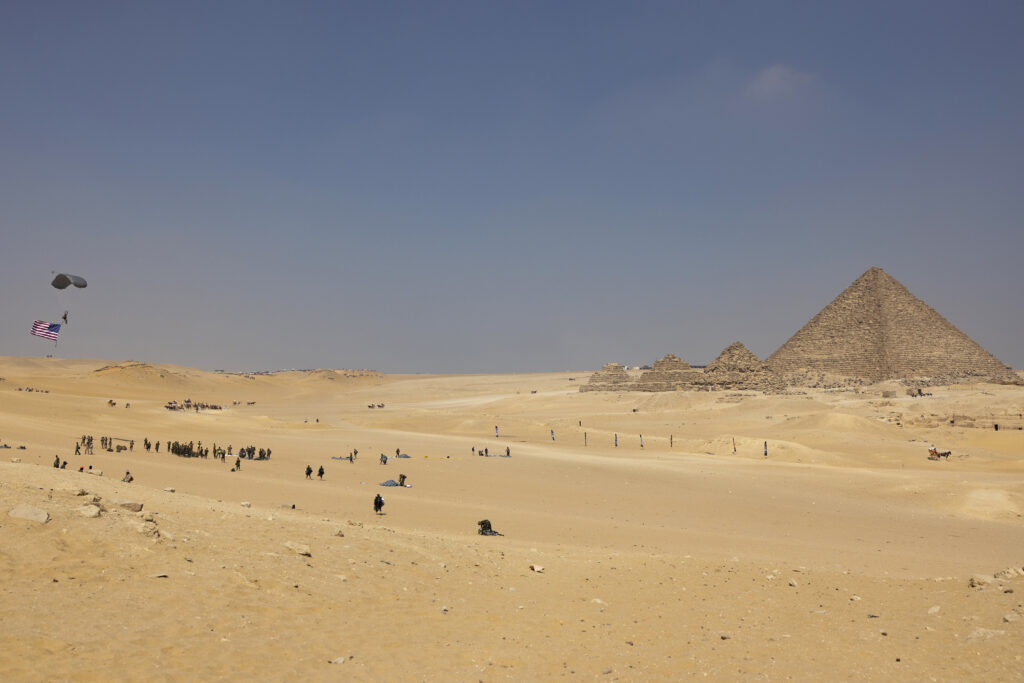
On 8 September 2025, the Egyptian desert was the stage for one of the most ambitious airborne exercises in recent years. At Mohamed Naguib Military Base in Hammam, Marsa Matrouh Governorate, paratroopers from more than 40 nations jumped into action as part of Exercise Bright Star 25, the latest edition of a storied multinational drill that has been running since 1980.
The event featured a combined force of paratroopers from the United States, Egypt, Saudi Arabia, and dozens of other countries, executing a large-scale airborne insertion followed by a simulated counterterrorism raid. The scenario was designed to test interoperability across multiple domains—military, civil defense, and humanitarian aid—under conditions that mimicked the chaos of modern conflict.
For Cairo, Washington, and their many partners, this was more than a training event. It was a demonstration of multinational solidarity, crisis readiness, and the ability to integrate forces at speed in one of the world’s most strategically contested regions.
Bright Star: A Legacy of Cooperation
Bright Star has its roots in the aftermath of the Camp David Accords and the evolving U.S.–Egyptian defense partnership. First held in 1980, the exercise quickly grew into one of the largest multinational military drills under U.S. Central Command (CENTCOM). Traditionally hosted every two years, Bright Star brings together militaries from across the Middle East, Africa, Europe, and beyond.
Over the decades, Bright Star has evolved from conventional field training to encompass urban warfare, counterterrorism, cyber operations, maritime security, and humanitarian relief. Its longevity is a testament to the durability of U.S.–Egyptian ties and the willingness of partners—Arab states, NATO allies, African contributors, and increasingly Asian participants—to share the same battlespace for collective readiness.
The Mohamed Naguib Military Base, inaugurated in 2017 and the largest in the Middle East, has become the focal point of these exercises. Its sprawling desert ranges and built-up training facilities allow forces to practice combined-arms maneuvers, air-ground integration, and disaster-response drills under realistic conditions.
Bright Star 25 drew troops from more than 40 countries, with the United States, Egypt, and Saudi Arabia forming the core of the airborne element. Other participants included NATO allies, Gulf Cooperation Council partners, and a diverse array of African and Asian states.
United States: Provided airborne infantry, special operations elements, and airlift platforms. American paratroopers jumped alongside Arab and African partners, demonstrating tactical proficiency and providing expertise in combined-jump coordination.
Egypt: Deployed airborne commandos and armored support units. Egyptian forces played dual roles: as hosts familiar with the terrain and as active participants in the urban raid scenario.
Saudi Arabia: Fielded paratroopers and air-mobile units, marking their growing role in multinational exercises beyond the Arabian Peninsula.
Other nations: From European paratroopers to African light infantry, contributions reflected the wide reach of Bright Star. Each contingent added not just manpower but also unique national expertise in desert operations, urban combat, or crisis response.
This diversity was central to the exercise. Rarely do so many militaries combine in a single operation, especially for airborne insertions—one of the most technically demanding forms of warfare.
The airborne operation began with multi-aircraft lifts, dropping multinational paratroopers over designated zones near the base. Both static-line jumps from lower altitudes and high-altitude freefall insertions were practiced, reflecting the different doctrines and capabilities of participating nations.
Coordinating an airborne assault across dozens of national contingents tested command-and-control systems, radio interoperability, and safety protocols. Each paratrooper, regardless of flag, was required to integrate seamlessly into mixed units on the ground.
Upon landing, forces consolidated into assault teams and began their advance toward the simulated urban target. The exercise planners had designed a complex terrorist-attack scenario, featuring smoke, explosions, and disorienting battlefield effects to mirror the confusion of real combat zones.
The ground operation at Mohamed Naguib unfolded as an exceptionally detailed and high-pressure counterterrorism simulation designed to immerse participants in the full complexity of modern urban combat. Once multinational paratroopers had consolidated after their insertion, they were immediately thrust into a dense urban training grid rigged with controlled detonations, simulated mortar impacts, and the sensory overload of smoke and noise effects. Assault teams were required to advance street by street and building by building, practicing live-fire maneuver under conditions meant to disorient and exhaust. Ambushes staged by role-players forced rapid changes of direction and on-the-spot tactical coordination, testing not only fire discipline but also the ability of mixed-nationality units to understand one another’s commands in real time. Rappelling specialists took high ground positions by fast-roping down onto rooftops, securing vantage points from which to provide overwatch and suppress hostile positions. Breach teams simultaneously worked methodically through stairwells and entryways, employing both mechanical and explosive techniques to gain entry, with room-clearing sweeps carried out in precisely timed sequences. A critical part of the drill involved a chemically contaminated zone: CBRN defense units deployed detection devices, carried out sampling, marked contaminated areas, and guided assault elements through safe lanes while conducting containment and clearance protocols. This phase highlighted the complexity of fighting when conventional firepower overlaps with unconventional threats, requiring not just combat effectiveness but also strict adherence to protective measures and decontamination drills.
Beyond combat action, the scenario deliberately expanded into civil-defense and humanitarian tasks. Military engineers and firefighting crews moved in to extinguish blazes triggered by staged explosions, showing how combat and disaster-response skills must overlap in a real environment. Aid packages were offloaded under pressure and distributed to designated areas, simulating the provision of relief to displaced civilians in an unstable battlespace. Medical evacuation teams rehearsed battlefield triage, with role-players acting as casualties suffering from trauma, burns, and chemical exposure. Medics stabilized patients under simulated fire, coordinated evacuation routes, and transferred them to mobile field hospitals, emphasizing the life-saving dimension of crisis response. By blending kinetic drills with stabilization and relief operations, the raid underscored the dual reality of modern crises: militaries must be prepared not only to neutralize adversaries but also to stabilize and protect civilian populations in the same operational window.
The training objectives of this operation were far broader than tactical marksmanship or unit cohesion. The first objective was airborne integration: paratroopers from more than forty nations needed to prove they could jump, land, and reorganize into cohesive assault teams despite different languages, doctrines, and equipment. Next was urban warfare proficiency, which meant practicing not only room-to-room clearing but also complex rooftop maneuvers, stairwell assaults, and coordination across multiple vertical levels in an urban grid. A third focus was CBRN readiness—detecting, isolating, and surviving in contaminated environments while maintaining mission tempo. The fourth aim involved civil-military coordination, demonstrating how soldiers, firefighters, medics, and logistics personnel could act in concert under attack conditions to deliver aid and restore stability. Finally, the entire raid stress-tested multinational command: staff officers and field leaders were forced to translate across languages, align different tactical cultures, and make coherent decisions at speed, ensuring that the coalition could act as a single body despite its diversity. These objectives reflected Bright Star’s evolution from a conventional drill into a multidimensional readiness laboratory where interoperability, trust, and crisis-management capability are cultivated simultaneously.
The strategic context surrounding Bright Star 25 explains why so much emphasis was placed on rapid response and coalition integration. Egypt’s location at the junction of Africa, the Middle East, and the Mediterranean gives it immense geostrategic weight, with access to the Suez Canal, the Eastern Mediterranean, and North African theaters. The Mohamed Naguib Base, positioned near key maritime approaches, allows participants to rehearse scenarios that could just as easily unfold in Libya, the Levant, or the Red Sea littorals. For the United States, continued investment in Bright Star reaffirmed its long-term commitment to regional security under CENTCOM, even while strategic focus expands to other theaters. For Arab partners such as Saudi Arabia, the exercise signaled a deliberate intent to train shoulder to shoulder not just with Egypt but also with Western and Asian militaries. For smaller nations, Bright Star offered exposure to doctrines, equipment, and environments that would be impossible to replicate at home. Central to all of this was the re-emphasis on airborne operations, which demonstrated the ability of a coalition to insert combat power rapidly into contested zones with little notice. In an era of hybrid threats, insurgent tactics, and irregular warfare, the ability to drop forces from the sky and transition instantly into both combat and stabilization roles has renewed significance.
Equally important were the humanitarian and civil dimensions deliberately woven into the scenario. Militaries in the twenty-first century are repeatedly asked to manage missions that do not stop at defeating hostile forces but also involve delivering relief, stabilizing civilian areas, and mitigating disasters. In the past two decades, from counterinsurgencies in the Sinai to refugee surges along regional borders, Egypt has faced such challenges firsthand. By simulating firefighting, aid distribution, and medical evacuation in the same space as counterterrorism operations, Bright Star 25 acted as a laboratory for whole-of-government and multinational responses. Civilian agencies, soldiers, and foreign partners worked side by side, rehearsing how to provide security, humanitarian support, and governance continuity in the immediate aftermath of violence. This fusion reflects the operational truth that modern crises are rarely purely military or purely civilian—they demand integrated approaches where uniforms and civilian responders share the same battlespace.
The airborne assault and subsequent simulated raid on 8 September 2025 encapsulated the ethos of Bright Star 25: complexity, realism, and multinational cooperation under extreme stress. From mass parachute insertions to rooftop rappelling, from chemical-defense drills to humanitarian relief delivery, the exercise tested every dimension of crisis response. It reinforced Egypt’s status as a hub of multinational training, validated U.S.–Egyptian defense partnership, and projected a message of resilience and interoperability to both allies and adversaries. More broadly, it demonstrated that the coalition of over forty nations was not simply rehearsing a battle but making a commitment to shared security, to collective readiness, and to the stabilization of crises before they spiral beyond control. As the dust settled on the ranges of Marsa Matrouh, Bright Star 25 stood as proof that twenty-first century militaries must be versatile instruments—capable of decisive combat, rapid humanitarian action, and seamless multinational coordination, all within the same operational cycle.