
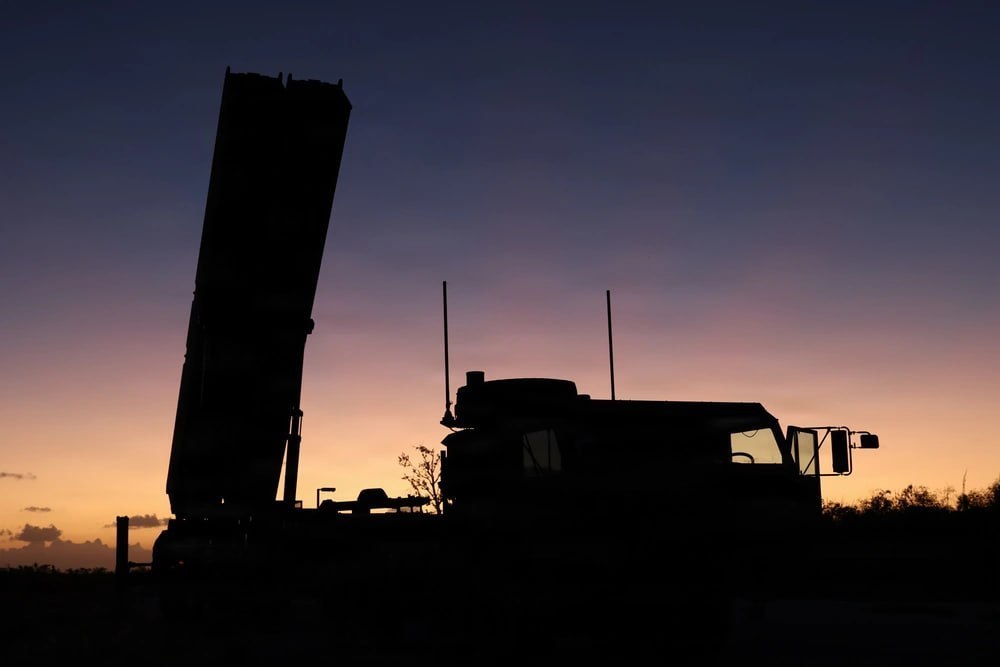
The United States Army deployed its ground-based Long-Range Hypersonic Weapon, known as Dark Eagle, to Guam during preparations and training associated with the multinational Valiant Shield 2026 exercise. The deployment placed one of the Army’s most advanced long-range strike systems on a strategically important American island in the western Pacific. It also demonstrated that the service can transport, position, operate, and integrate the large hypersonic weapon system thousands of miles from its home station.
Official U.S. Army photographs published on July 20, 2026 showed soldiers training with Dark Eagle while Adm. Samuel J. Paparo, commander of U.S. Pacific Command, observed the activity. The weapon was assigned to the 7th Infantry Division’s Multi-Domain Command-Pacific organization.
The original photographs did not identify their precise location. Army Maj. Jimmy Sheehan, a U.S. Pacific Command spokesman, subsequently confirmed to Stars and Stripes that the images had been taken on Guam.
Dark Eagle Appears on Guam
The Defense Visual Information Distribution Service record states that the Dark Eagle training photographs were taken on June 6, 2026, and publicly released on July 19. The official Valiant Shield exercise window ran from June 22 through July 1 across Guam, Japan, the Commonwealth of the Northern Mariana Islands, and the surrounding maritime training areas. The dates indicate that the photographed Dark Eagle activity occurred before the formally announced exercise period, most likely during advance deployment, preparation, integration, or rehearsal.
The Army still described the training as part of Valiant Shield. The system may have arrived early so crews could prepare the launcher, establish communications, connect with the exercise command structure, and validate operational procedures before the larger joint-force event began. The Army has not released a detailed deployment timeline.
There is also no public indication that Dark Eagle was launched during the exercise. The available evidence confirms that the system was transported to Guam and used for training. It does not establish that a missile was fired, that live rounds were present, or that the system remained on Guam after Valiant Shield ended.
That distinction matters. Moving a weapon system into a theater, connecting it to operational networks, and practicing employment procedures are significant military activities. They are still different from conducting a live-fire mission or establishing a permanent operational battery.
What Is the Dark Eagle Hypersonic Weapon
Dark Eagle is the Army’s ground-launched, conventionally armed hypersonic strike system. Its formal designation is the Long-Range Hypersonic Weapon, commonly abbreviated as LRHW. The system combines a road-mobile launcher, a two-stage rocket booster, a Common Hypersonic Glide Body, fire-control equipment, communications systems, and supporting vehicles.
After launch, the rocket booster accelerates the glide body to hypersonic velocity. The glide body then separates from the booster and travels through the upper atmosphere while retaining the ability to maneuver toward its target. A Congressional Research Service report published through USNI News described Dark Eagle as a conventional precision-strike weapon intended for time-sensitive and heavily defended targets in contested environments.
The same report states that the Common Hypersonic Glide Body can travel at Mach 5 or higher. Its maneuvering flight path may make it more difficult to detect, track, predict, and intercept than a conventional ballistic missile following a comparatively predictable trajectory.
Dark Eagle shares important components with the U.S. Navy’s Conventional Prompt Strike program. The Army operates the land-based configuration, while the Navy is developing maritime launch configurations for surface ships and submarines. This common architecture is intended to reduce duplicated development and create a shared industrial base for boosters, glide bodies, thermal-protection materials, testing infrastructure, and specialized manufacturing.
Dark Eagle Is Moving Beyond the Prototype Stage
Dark Eagle emerged from a rapid prototyping program led by the Army Rapid Capabilities and Critical Technologies Office. The Army delivered initial ground equipment to soldiers before the development program had completed every planned flight test.
That approach allowed Army personnel to begin learning how to transport, emplace, maintain, and operate the system while engineers continued working on the missile itself. Dark Eagle experienced several testing and integration delays during its development. Earlier planned fielding dates slipped after canceled or unsuccessful test events exposed problems involving launch preparation, system integration, and missile production. The program has since moved closer to regular production. In March 2026, Army Contracting Command awarded a $2.7 billion contract supporting Dark Eagle. The Army described the award as an important milestone toward accelerated fielding.
A separate Leidos announcement said the contract would move the Common Hypersonic Glide Body and its thermal-protection system from prototyping into production. Reuters reported that the agreement was intended to shorten production timelines and establish a more reliable supply of critical components for both the Army and Navy hypersonic programs. The Guam deployment should therefore be understood as part of a transition. Dark Eagle retains its developmental history and continues to mature, while the Army is moving the system toward serial production and sustained operational use.
Why Guam Matters
Guam occupies a central position in American military planning for the western Pacific. The island hosts Andersen Air Force Base, Naval Base Guam, logistics facilities, communications infrastructure, fuel storage, ammunition support, and command organizations. It can support military operations extending toward Japan, the Philippine Sea, the Korean Peninsula, the South China Sea, and the broader western Pacific.
Guam is also a United States territory. Washington can deploy American forces there without negotiating temporary access with a foreign host government. That gives the Pentagon greater control over infrastructure, construction, training, storage, and operational planning. Placing Dark Eagle on Guam demonstrates that the Army can introduce a long-range offensive missile capability into an established American military hub. It also allows the Army to study how the weapon would function alongside aircraft, naval forces, space-based sensors, intelligence systems, air defenses, and other land-based missile units.
The deployment does not establish that Guam will become Dark Eagle’s permanent base. It demonstrates that the island can receive and support the system during exercises or future contingencies. That mobility is central to the Army’s multi-domain strategy. A launcher that can be moved between Guam, Australia, Japan, the Philippines, or other available locations creates a more complicated planning problem than a weapon tied to a single permanent installation.
The Public Range Figures Remain Inconsistent
Dark Eagle’s exact operational range has not been publicly established with complete consistency. The Congressional Research Service reported a range of approximately 1,725 miles. Other defense reporting, including the Stars and Stripes account of the Guam deployment and a subsequent USNI News analysis, used a figure of approximately 2,175 miles.
The Army has not publicly reconciled these figures. The difference may involve changes in system configuration, demonstrated range, projected maximum range, launch geometry, flight profile, or the amount of terminal maneuvering required.
For that reason, claims identifying specific targets that Dark Eagle could reach from Guam should be treated cautiously. Under the higher public estimate, portions of coastal China could fall within the system’s potential reach. Under the lower Congressional Research Service figure, coverage from Guam would be more restricted.
Operational range also depends on more than the distance between two points. Flight-path restrictions, defended airspace, required maneuvering, terminal speed, launch position, target location, and mission planning would all affect the weapon’s practical engagement envelope.
A Weapon for High-Value Targets
Dark Eagle is not intended to replace conventional artillery, cruise missiles, or shorter-range ballistic systems. Its likely purpose is to attack a limited number of high-value targets that are distant, heavily defended, time-sensitive, or critical to an opponent’s military operations. Potential target categories could include command centers, long-range missile infrastructure, integrated air-defense nodes, strategic communications facilities, hardened military installations, and other high-priority objectives.
The weapon’s speed could reduce the interval between launch and impact. Its maneuverability could complicate warning and interception. Its range could allow an Army unit to strike from outside the effective reach of many conventional defensive systems.
Dark Eagle would still depend on an extensive network of external capabilities. The launcher must receive accurate targeting data. Commanders must identify and authorize the target. Intelligence systems must determine whether the target remains present and operational. Communications networks must transmit mission information securely and quickly. The missile is therefore one part of a larger kill chain connecting satellites, aircraft, unmanned systems, ships, ground sensors, intelligence organizations, command centers, and strike units.
The presence of Adm. Paparo during the Guam training highlights this joint-force dimension. The most important question was not simply whether soldiers could operate the launcher. The exercise also tested how the system could be integrated into a Pacific-wide command structure involving multiple military services and allied forces.
Valiant Shield Provided the Joint Operational Environment
Valiant Shield 2026 was a large, biennial field-training exercise designed to integrate American, allied, and partner forces across the air, maritime, land, space, and cyber domains. According to U.S. Pacific Command, the exercise involved roughly 14,000 American service members, more than 200 aircraft, approximately 20 surface ships, and participation from Japan, Australia, Canada, and New Zealand.
The exercise included distributed operations across thousands of miles. Forces trained under conditions intended to represent disruption, contested communications, long-distance logistics, and attacks involving several operational domains.
Dark Eagle’s presence allowed the Army to place the system inside that larger environment. Crews could practice receiving orders, coordinating with other commands, moving equipment, maintaining communications, and protecting a large missile battery while other forces conducted simultaneous operations.
These activities provide information that cannot be obtained through an isolated missile test. A successful flight test establishes whether the weapon can launch and travel toward a target. An operational exercise examines whether the entire organization surrounding the weapon can function under realistic conditions.
The Army Has Already Tested Overseas Deployment
Guam was not Dark Eagle’s first appearance outside the continental United States. In July 2025, the Army deployed Dark Eagle ground equipment to Australia’s Northern Territory during Exercise Talisman Sabre. The Army described that event as the system’s first operational employment outside the continental United States.
Personnel from B Battery, 5th Battalion, 3rd Field Artillery Regiment provided capability briefings and trained with the system in Australia. An Army University Press account of the deployment identified the event as a significant step in developing expeditionary long-range fires.
The Guam deployment extended that process. Australia demonstrated that Dark Eagle could be carried into an allied country and incorporated into a multinational exercise. Guam demonstrated employment from American territory much closer to the primary operating areas of U.S. Pacific forces.
Repeated deployments also allow the Army to identify practical limitations involving strategic airlift, road access, launcher emplacement, communications, maintenance, concealment, security, and resupply.
Dark Eagle is physically large. Its launchers and support vehicles require substantial transportation and logistics. The system must also survive in an environment where an opponent would attempt to locate and attack it before launch. Mobility alone does not guarantee survivability. Effective employment would require dispersion, camouflage, deception, air and missile defense, secure communications, rapid displacement, and carefully selected operating locations.
Strategic Signaling Toward China
The Guam deployment carries an unavoidable strategic message. China has developed a large inventory of land-based ballistic, cruise, and hypersonic weapons intended to hold American bases, ships, and regional forces at risk. Guam is itself considered a potential target during a major western Pacific conflict.
Deploying Dark Eagle there shows that Guam can support offensive long-range fires alongside its existing air, naval, logistical, and defensive missions. It also demonstrates that the United States is developing options to strike distant targets rapidly from land-based positions.
The signal extends beyond China. Allies and partners can see that the Army is moving the system through real transportation networks and integrating it into major exercises. Potential adversaries must account for the possibility that Dark Eagle batteries could appear at different locations during a crisis.
The deployment could also intensify regional concerns about missile proliferation, escalation, and arms competition. A long-range hypersonic launch may provide limited warning, and an opponent observing the initial launch may have incomplete information about the weapon’s target, payload, or mission.
These uncertainties can increase pressure on national command authorities during a crisis. Dark Eagle is conventionally armed, yet the speed and trajectory of any long-range missile can complicate threat assessment and escalation control.
What the Deployment Proves
The Guam appearance does not prove that Dark Eagle has achieved complete operational maturity. It does prove several narrower and important points. The Army transported the system into the western Pacific. Soldiers conducted training with it on Guam. The weapon operated within the command environment of a major multinational exercise. Senior Pacific leadership observed the activity. The Army subsequently released the deployment publicly.
Those facts show progress beyond laboratory development and isolated testing. The next measures of maturity will involve reliable production, delivery of operational missiles, trained battery availability, logistical sustainability, testing under increasingly demanding conditions, and the ability to deploy repeatedly without extensive developmental support.
Dark Eagle’s strategic importance will ultimately depend on whether the Army can produce enough missiles, maintain them, supply trained crews, protect the launchers, obtain timely targeting data, and integrate the weapon into a larger joint campaign.
A New Phase for Army Long-Range Fires
Dark Eagle’s deployment to Guam represents a significant stage in the Army’s effort to rebuild long-range, theater-level strike capabilities. The system is no longer confined to development facilities or continental test ranges. It has now appeared during major exercises in Australia and Guam, two strategically important locations for American operations in the Indo-Pacific.
The Guam deployment also shows how the Army’s regional role is changing. Land forces are being prepared to influence air and maritime campaigns through long-range missiles, air defense, sensors, communications, and distributed command systems. Several questions remain unanswered. The Army has not disclosed whether live missiles were present, where the system was positioned, how long it remained on Guam, or whether future deployments will become routine. The weapon’s exact operational range, available inventory, and sustained fielding schedule also remain partly uncertain.
Even with those limitations, the deployment was more than a static equipment display. It was a practical demonstration that the United States can move a ground-based hypersonic strike system into Guam and connect it to a large Pacific exercise.
That capability changes the military planning problem in the region. It gives American commanders another potential method for placing distant, defended, and time-sensitive targets at risk while expanding the Army’s role in joint operations across the western Pacific.